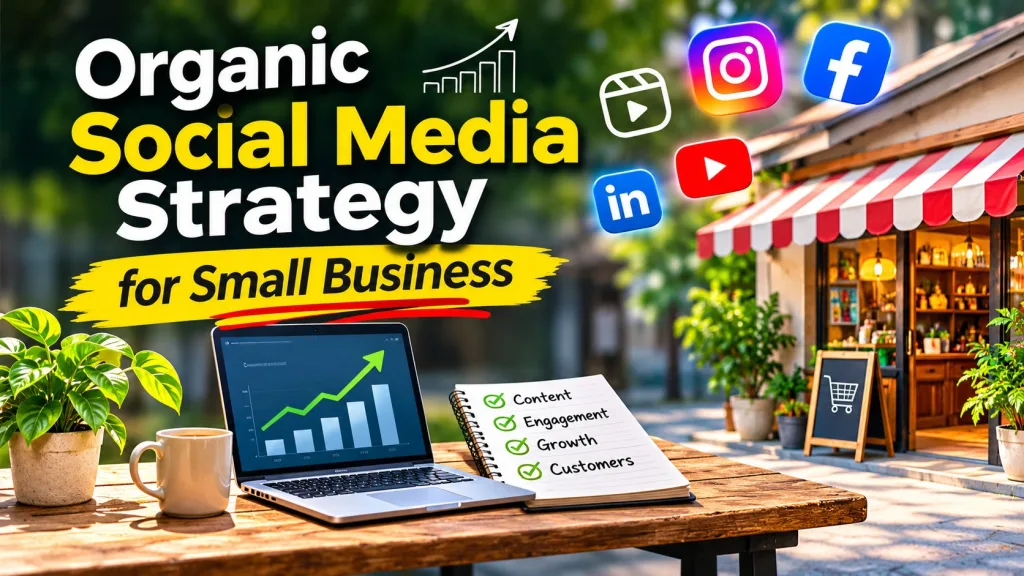
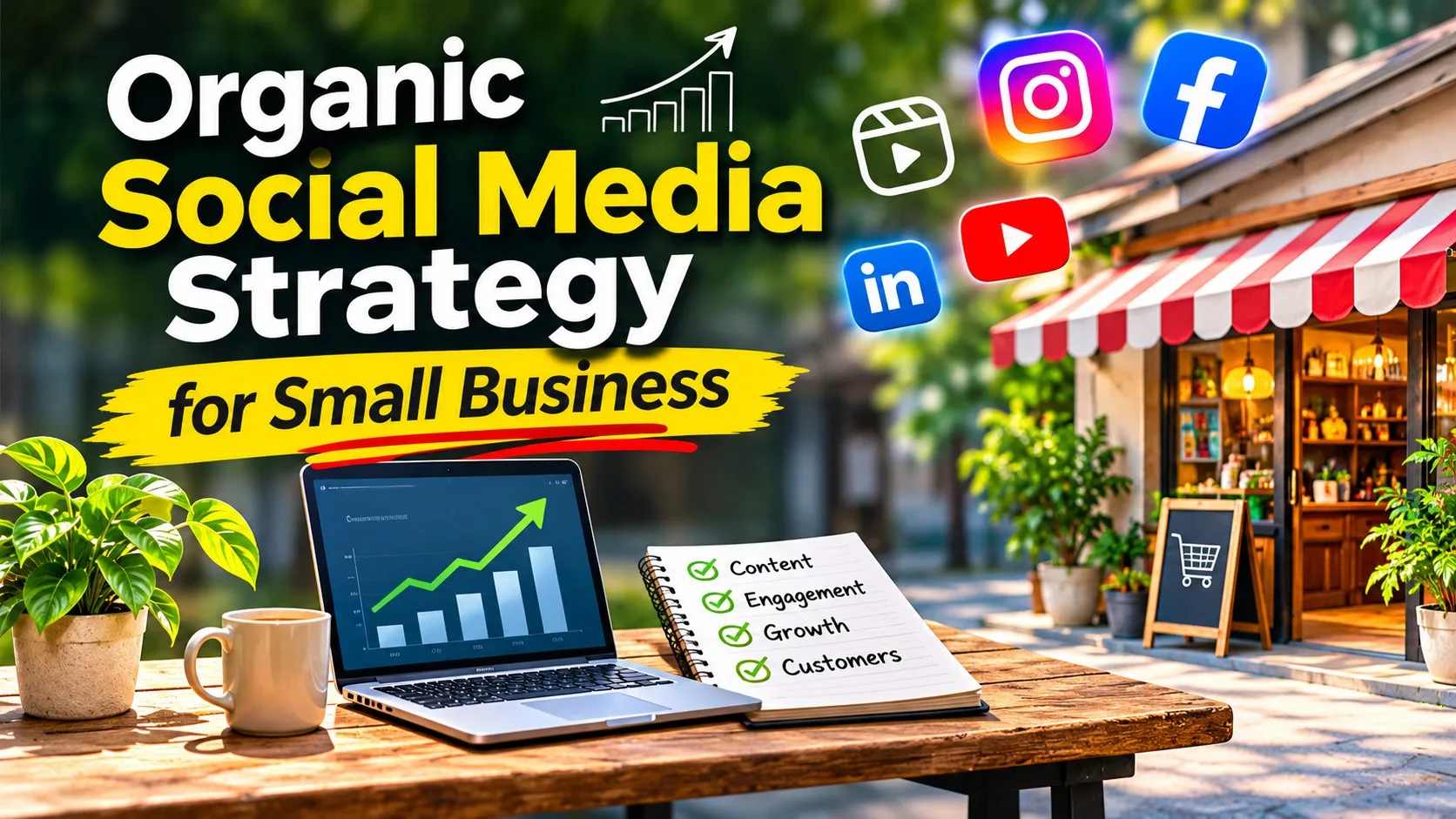
Organic social media marketing helps a small business build familiarity, answer customer questions and generate enquiries without paying to distribute every post. It is not free of effort: it takes planning, useful content, timely replies and measurement. These activities are one part of a broader organic digital marketing approach that also includes SEO, content marketing and audience engagement. The most sustainable approach is to choose one clear business goal, focus on the platform your customers actually use, and publish consistently at a pace your team can maintain.
This guide is designed for owner-managed businesses and small teams. It includes a practical platform-selection framework, content pillars, a weekly workflow, measurement guidance and a 30-day starter plan. Use the examples as starting points and adapt them to your industry, location and customers.
What organic social media means
Organic social media is the unpaid activity a business carries out on social platforms: publishing posts and short videos, sharing stories, responding to comments and messages, participating in relevant communities, and collaborating with customers or complementary businesses. It differs from paid social advertising, where a business pays to distribute content to a selected audience.
Organic activity can support awareness, trust, customer service, referrals and lead generation. However, reach is not guaranteed. Platform algorithms, audience behaviour and competition change, so do not build your entire customer-acquisition plan around one social account. Use social to create useful touchpoints and guide interested people towards a website, enquiry form, email list or permission-based messaging channel.
Step 1: Set one business goal and define the audience
Start with one priority for the next 90 days. A clear goal makes it easier to decide what to publish and what results to measure. Avoid treating followers, likes and sales as interchangeable outcomes.
| Business goal | Action you want people to take | Useful measures |
|---|---|---|
| Awareness | Discover and remember the business | Reach, relevant profile visits, branded searches |
| Enquiries | Send a message, call or submit a form | Qualified enquiries, form submissions, calls |
| Sales | Visit a product page or place an order | Orders, revenue, conversion rate, assisted sales |
| Retention | Return, recommend or engage again | Repeat purchases, customer replies, referrals |
Next, write a one-sentence audience description: who they are, what they need, where they are and what makes them choose a provider. For example: “Families in Thrissur looking for a reliable custom cake maker for birthdays and celebrations.” This is more useful than a broad label such as “everyone who likes cakes.”
Use customer conversations, enquiry forms, reviews and frequently asked questions to validate the description. Do not assume that your own interests are the same as your customers’ interests.
Step 2: Choose the platform your customers use
You do not need to publish everywhere. Choose one primary platform based on customer behaviour, the type of content you can produce and the action you want people to take. Add another platform only when you can maintain the first without sacrificing service quality.
| Platform | Often useful for | Content to test | Practical consideration |
|---|---|---|---|
| Visual products, food, fashion, beauty and local services | Reels, carousels, Stories, product demonstrations | Use original visuals and make contact or booking steps clear | |
| Local communities, events, neighbourhood businesses and customer groups | Useful updates, short videos, events and community posts | Participate genuinely; do not rely only on Page reach | |
| B2B services, consultants, recruitment and professional expertise | Practical advice, case studies, documents and expert commentary | Show evidence and insight rather than posting constant sales pitches | |
| YouTube | Demonstrations, education, reviews and searchable video answers | How-to videos, explainers, Shorts and customer questions | Plan for useful titles, clear audio and a sustainable production schedule |
| WhatsApp Business | Customer support and updates for people who have chosen to hear from you | Status updates, catalogues and relevant one-to-one replies | Get permission, respect opt-outs and avoid unsolicited bulk messages |
| TikTok | Short-form discovery where the intended audience is active | Demonstrations, behind-the-scenes clips and creator-style explainers | Check audience fit and local availability before committing resources |
Before choosing, ask recent customers where they discovered you and which platforms they use. Review enquiries and website analytics as well. Your own customer evidence is more valuable than a generic ranking of the “best” platform.
Step 3: Create three or four useful content pillars
Content pillars are recurring themes that make planning easier and keep your account useful. A balanced starting framework is to educate, demonstrate, build trust and show the human side of the business.
| Content pillar | Purpose | Example for a local bakery | Example for a service business |
|---|---|---|---|
| Educate | Answer questions and explain choices | How to choose cake size for a gathering | How to prepare for a website redesign |
| Demonstrate | Show the product, process or result | Decorating process and finished orders | A short screen recording of a completed task |
| Build trust | Provide verifiable proof and reduce uncertainty | Customer feedback shared with permission | A documented project example with client approval |
| Connect | Show the people and values behind the business | Meet the baker or show a preparation day | Introduce the team and explain how you work |
Avoid treating any content ratio as a universal rule. As a simple starting point, make most posts helpful or demonstrative, include regular proof and community content, and use direct promotional posts selectively. Review the response and adjust the mix to your audience and business objective.
Build your ideas from real customer questions. Keep a note on your phone or in a shared document. Each repeated question can become a short video, carousel, FAQ post, blog article or story.
Step 4: Set a realistic publishing rhythm
A schedule is useful only if you can maintain it. Start with two or three strong posts per week if that fits your capacity; fewer high-quality, relevant posts are preferable to a daily schedule that causes rushed content or unanswered enquiries. There is no posting frequency that guarantees reach.
| Time available each week | Possible starting rhythm |
|---|---|
| About 2 hours | Two simple posts and short daily checks for important messages |
| About 4 hours | Three posts, including one short video, plus planned engagement |
| About 6 hours | Three to four posts, Stories or community activity, and a weekly review |
Try this repeatable workflow:
- Plan: choose topics that support this month’s business goal.
- Create in batches: capture several product or process photos and videos in one session.
- Write for the platform: use a clear opening, one main idea and a relevant next step.
- Schedule or publish: check links, spelling, accessibility and mobile appearance before posting.
- Engage: respond to genuine questions and comments; move sensitive customer details to a private channel.
- Repurpose thoughtfully: adapt a useful idea for another format rather than copying the same post everywhere without context.
Step 5: Build relationships and respond well
Social media is not only a publishing channel. It is also a place where customers ask questions, compare options and share experiences. Treat replies as part of customer service, not as an afterthought.
- Answer the question: give a specific, helpful response instead of a generic “Thanks”.
- Set response expectations: state business hours and the best contact route in your profile.
- Protect customer information: do not ask people to post phone numbers, order details or private information publicly.
- Participate in relevant communities: contribute useful answers and follow group rules; avoid repetitive promotional comments.
- Request permission before sharing: obtain consent before reposting customer photos, testimonials or messages.
- Collaborate where there is a genuine fit: partner with complementary local businesses on a useful event, guide or offer.
Step 6: Turn attention into enquiries and repeat business
A follower is not automatically a lead. Make the next step clear and easy: call, request a quotation, book an appointment, visit a product page, download a resource or join an email list. Choose one primary call to action for each post instead of asking people to do several things at once.
- Complete your profile: explain what you offer, who you serve, your service area and how to contact you.
- Use a relevant destination: link to the exact service, product, booking or enquiry page rather than always sending visitors to the homepage.
- Offer something genuinely useful: for example, a checklist, product guide, sample or consultation details.
- Use permission-based follow-up: collect email or WhatsApp consent clearly and explain what updates people will receive.
- Measure the journey: use tagged links and record the source of enquiries in your CRM or lead sheet.
- Follow up appropriately: respond promptly, answer the question and respect people who do not want further messages.
For businesses serving a defined area such as Thrissur or Irinjalakuda, make location information easy to understand. Show the actual service area, operating hours and directions where relevant. Keep your social profiles, website and Google Business Profile details consistent, and do not imply that you serve locations you cannot realistically cover.
Step 7: Measure business outcomes, not vanity metrics
Choose a small set of measures that match your goal. Reach and engagement can help explain distribution and interest, but enquiries, qualified leads, bookings and sales show whether social activity is contributing to business results.
| Goal | Review | Questions to ask |
|---|---|---|
| Awareness | Reach, relevant profile visits, video watch time | Are the right people discovering the business? |
| Enquiries | Messages, calls, form submissions and qualified leads | Which posts or topics lead to useful conversations? |
| Sales | Orders, revenue, conversion rate and assisted conversions | Can sales be connected to social activity with reasonable confidence? |
| Retention | Repeat orders, customer replies and referrals | Does content help existing customers stay informed and return? |
Use platform analytics alongside website analytics and your enquiry records. Add UTM parameters to campaign links where appropriate, and ask new customers how they heard about you. Attribution is imperfect: a person may see a post, search for the business later and then call. Record the evidence you have instead of claiming every sale came from one post.
Review performance monthly. Compare similar periods, identify the posts that attracted the most relevant responses, and look for patterns in topic, format and audience. Do not delete a useful topic simply because one post received few likes.
A practical 30-day organic social media plan
This starter plan is intended to establish a workable system, not to promise a specific number of followers or sales. Adjust the workload to your available time.
| Period | Focus | Actions |
|---|---|---|
| Days 1–7 | Foundation | Choose one 90-day goal; describe the audience; select a primary platform; update the profile and contact route. |
| Days 8–14 | Content planning | Choose three or four pillars; list at least 12 customer questions; prepare the first week of content. |
| Days 15–21 | Publish and engage | Publish two or three useful posts; answer comments and enquiries; note which topics prompt meaningful responses. |
| Days 22–30 | Conversion and review | Publish another two or three posts; add a relevant call to action; check link and enquiry tracking; plan the next month. |
Common organic social media mistakes
| Mistake | Better approach |
|---|---|
| Trying to manage every platform | Start with the platform your customers use most and expand only when ready. |
| Publishing only offers and discounts | Balance promotion with education, demonstrations and customer proof. |
| Posting without responding | Make replies and enquiry handling part of the weekly workflow. |
| Using likes as the only success measure | Track the action that matters to the business goal. |
| Copying competitors | Use customer questions, real work and your own expertise to create distinctive content. |
| Buying followers or engagement | Build an audience through relevant content and genuine interactions; artificial engagement can distort your data. |
| Sending unsolicited bulk messages | Use clear opt-in, relevant updates and a simple way to stop receiving messages. |
| Expecting instant sales | Use a consistent review cycle and assess the full customer journey. |
Frequently asked questions
How often should a small business post on social media?
Start with two or three useful posts per week if your team can sustain that rhythm. The right frequency depends on your audience, platform, content format and available resources. Review results and adjust rather than following a universal posting rule.
Which social media platform is best for a small business?
The best platform is the one your target customers use and where you can publish useful content consistently. Instagram may suit visual products, LinkedIn may suit B2B expertise, Facebook may help community-led local businesses, and YouTube may suit searchable demonstrations. Validate the choice with customer feedback and enquiry data.
Can organic social media generate leads without paid ads?
Yes, it can generate enquiries through useful content, referrals, community participation and clear calls to action. Results depend on demand, competition, audience fit, offer quality and consistency. Organic reach is not guaranteed, so use other suitable channels as well.
Do I need to show my face in social media content?
No. You can use product demonstrations, screen recordings, process videos, customer-approved stories, voiceovers and educational carousels. Showing the people behind a business can help build familiarity, but choose a format that feels authentic and comfortable.
Can AI tools help with organic social media?
AI tools can help brainstorm topics, organise a calendar, create first drafts and adapt content into different formats. Check facts, remove generic claims and add your own examples, experience and brand voice before publishing. Do not use AI-generated testimonials, fabricated case studies or images that misrepresent your products or team.
How long does organic social media take to work?
There is no reliable universal timeline. You can assess whether your publishing process is consistent and whether people are responding within the first month, but business outcomes may take longer and vary by market. Review your own baseline and progress over a sustained period.
A simple next step for your business
Do not begin by trying to post every day. Write down one business goal, identify one customer group and choose one platform. Then publish a small set of genuinely useful posts, respond to the people who engage and record the enquiries that follow. Improve the plan using your own customer and performance data.
For small businesses in Kerala, the same principle applies whether you serve one neighbourhood or customers across the state: make your offer clear, show real work, answer local customer questions and provide an easy way to contact you. For a wider view of the professional skills behind this work, read our guide to what an Organic Marketing Expert does.
Need help building a practical digital marketing plan? Explore Performing Marketer for digital marketing guidance, training and support. Choose the service or learning option that fits your business stage and goals.
For a wider growth plan that connects social media with SEO, content and email, explore our guide to what an organic digital marketing agency does. Course providers can also read our guide to organic marketing for course creators.