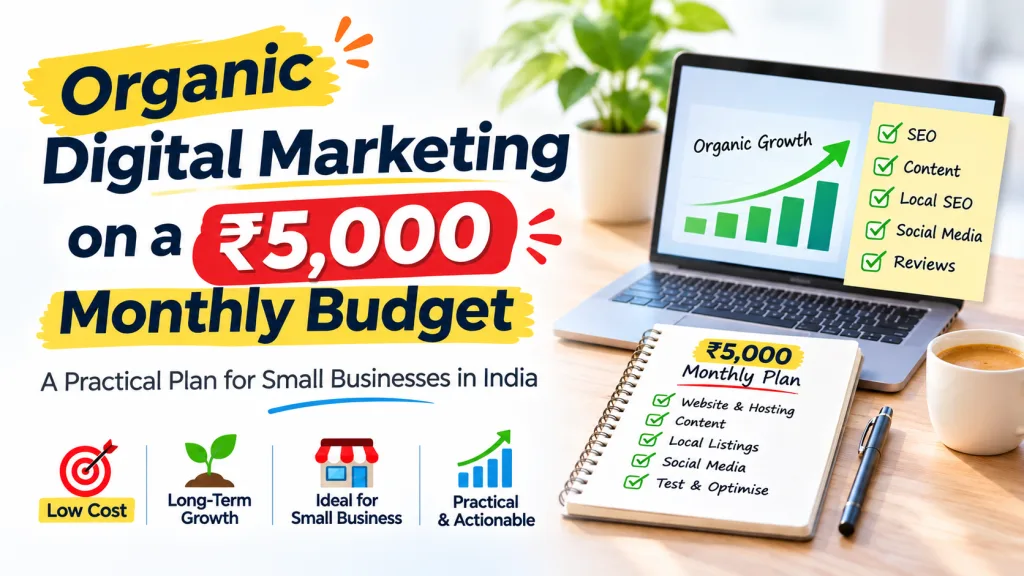
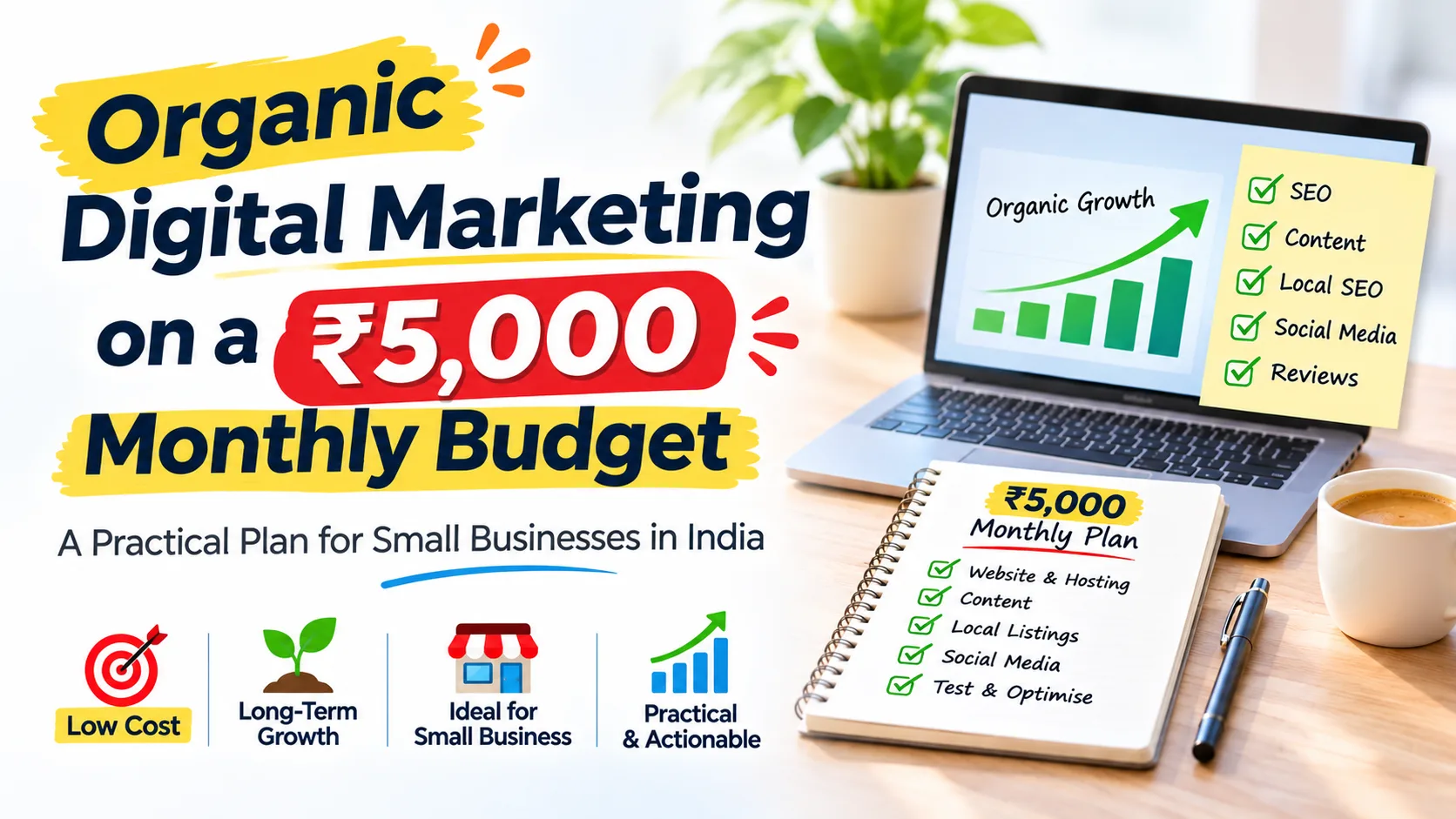
Organic Digital Marketing on a ₹5,000 Monthly Budget: A Practical Plan for Small Businesses in India
You do not need a large advertising budget or an expensive agency to start attracting customers online. With a focused plan and a monthly budget of ₹5,000, a small business in India can build its website presence, improve local search visibility, publish useful content and create more opportunities for customer enquiries.
The important part is knowing where to spend, what to do yourself and how to measure whether your effort is helping the business. This guide explains a realistic low-budget digital marketing plan, the free tools that can support it and a 90-day routine you can adapt to your business.
Whether you run a shop, a home-based business, a restaurant, a consultancy, a tuition centre or a local service company, the principles are similar: make it easy for customers to find you, understand what you offer and contact you.
1. What is organic digital marketing?
Organic digital marketing means attracting an audience through unpaid visibility and useful interactions rather than paying for every click or impression. It includes search engine optimisation (SEO), helpful website content, Google Business Profile optimisation, organic social media, YouTube videos, customer reviews and useful communication with existing customers.
For example, imagine that you own a bakery in Kochi. Someone searches Google for “eggless birthday cake in Kochi”. If your website and local business profile contain accurate, relevant information, your bakery may appear in the results. The customer can then view your products, read reviews and contact you.
Organic does not mean completely free. It takes time, skill and consistent effort, and you may spend on hosting, content editing, design or professional support. The advantage is that useful content and a well-maintained online presence can continue creating value after the initial work is complete.
Organic marketing vs paid marketing
| Organic marketing | Paid marketing |
|---|---|
| Builds visibility through useful content and optimisation | Buys visibility through advertising |
| Usually needs consistent effort over time | Can generate traffic soon after campaigns start |
| Useful content may attract visitors for months | Traffic generally reduces when campaigns stop |
| Helps build long-term search and brand presence | Useful for testing offers and reaching selected audiences |
| Requires time, skills and ongoing improvement | Requires an advertising budget and campaign management |
The two approaches can work together. Organic marketing builds a foundation; paid campaigns can help test an offer or reach a specific audience. A small business should not assume that either approach guarantees sales.
2. Why organic marketing suits small businesses
Small businesses often have limited budgets, small teams and little time to manage multiple channels. A focused organic marketing strategy helps avoid spreading effort too thinly.
Build visibility that can compound
A useful article answering a customer’s question can continue attracting search visitors after publication. For example, a website development company could publish “How much does a business website cost in Kerala?” and explain the factors that affect pricing. The article can attract people researching a website and guide relevant visitors towards its service page. For a broader framework, read our guide to organic strategies in digital marketing.
Build trust before the first enquiry
Customers often check a business website, reviews, photographs, service details and contact information before making a decision. Helpful content and accurate business information make it easier for people to assess whether the business is relevant to them.
Reduce dependence on continuous advertising
If every enquiry depends on an active advertising campaign, the business needs to keep funding that campaign. Organic work can create additional routes to discovery through search, local listings and useful content. It takes time, however, and should not be treated as an instant replacement for paid advertising.
For planning, allow an initial period of several months to build and assess organic activity. Three to six months can be a useful review horizon, not a guaranteed SEO result or ranking promise. Competition, website quality, location, demand and consistency all affect outcomes.
3. How to allocate a ₹5,000 monthly budget
Start with the essentials. Do not subscribe to several tools or promote every post simply because the budget is available.
| Activity | Monthly budget | Purpose |
|---|---|---|
| Website hosting and domain, averaged monthly | ₹600 | Maintain a website you control |
| Design tools and creative resources | ₹500 | Create social graphics and simple brochures |
| Content writing or editing support | ₹1,500 | Prepare useful articles and supporting posts |
| Listing and review management support | ₹400 | Maintain accurate local business information |
| Small promotional or retargeting test | ₹1,000 | Test a selected offer or message, if the basics are ready |
| Contingency | ₹1,000 | Unexpected costs and improvements |
| Total monthly budget | ₹5,000 | Planning example |
These are planning estimates, not fixed market prices. Your actual costs may be lower or higher depending on your existing website, subscriptions, service providers and skills.
Adjust the budget to your situation
If your website is already hosted and maintained, you may not need to allocate ₹600 every month. If you can write your own content, move some of the writing allocation towards website improvements or photography. If your local business profile is incomplete, prioritise fixing it before spending on promotion.
The ₹1,000 promotional allocation is optional. Do not run ads simply to use the budget. First make sure that the offer is clear, the landing page works on mobile and customers can contact you easily. If you do test advertising, define what counts as a useful result, such as a qualified enquiry, not just a click.
4. Set up free digital marketing tools first
Before paying for SEO subscriptions, set up the basic tools that help you understand search visibility, website activity and customer actions.
Google Search Console
Google Search Console shows how your website performs in Google Search. It can help you review search queries, impressions, clicks, pages appearing in results and indexing information.
For example, a local interior designer may notice impressions for searches related to “interior designer in Thrissur” or “small home interior design ideas”. These observations can help identify topics worth developing. Search Console data should be interpreted carefully: impressions do not automatically mean that a visitor is ready to buy.
Google Analytics 4
Google Analytics 4 helps you understand how visitors reach and use your website. You can review traffic sources, popular pages and configured events. For a small business, pay attention to meaningful actions such as enquiry form submissions, WhatsApp clicks and phone link clicks. Make sure those events are configured and tested rather than assuming they are being tracked automatically.
Google Business Profile
For businesses that serve customers at a physical location or within a defined service area, Google Business Profile is an important local visibility tool. Complete the profile with accurate business information, the right category, working contact details, hours, services and genuine photographs. Keep the information current and follow Google’s guidelines. Do not add keywords to the business name or create locations where you do not genuinely operate. If your profile has visibility or verification issues, see our Google Business Profile support.
Google Keyword Planner and Google autocomplete
Keyword Planner can provide keyword ideas and estimated search demand. Google autocomplete can also reveal how people phrase questions and service searches. Treat suggestions as research ideas, not proof of exact search volume or customer intent.
Other free or freemium tools can help with image design, spreadsheets and content planning. Start with tools that solve a real task; avoid collecting subscriptions that you rarely use.
5. Find keywords people in India actually search
Keyword research is about understanding what customers need, not collecting hundreds of phrases. Begin with around 20–30 relevant ideas and group them by intent.
Buyer-intent keywords
These searches suggest that someone may be looking for a product or service:
- “best [service] in [city]”
- “[product] price in India”
- “[service] near me”
- “digital marketing course in Malayalam”
- “website designer in Thrissur”
Use relevant buyer phrases naturally on service pages, product pages and useful location pages.
Problem-based keywords
These searches show that someone has a question or challenge:
- “how to get more customers for a small business”
- “why is my website not appearing on Google”
- “how to improve Instagram reach organically”
- “how to optimise Google Business Profile”
These topics can become blog posts, videos and educational social content.
Comparison and research keywords
These searches indicate that a person is evaluating options:
- “SEO vs Google Ads”
- “organic marketing vs paid advertising”
- “website vs social media marketing”
- “freelancer vs digital marketing agency”
Comparison content should explain the differences fairly and help the reader make an informed decision.
Choose one main topic for each page
For a page about SEO services in Thrissur, the primary phrase might be “SEO services in Thrissur”, with related terms such as “Local SEO services” and “SEO consultant in Kerala”. Use them naturally in the title, headings and relevant copy. Do not repeat keywords unnaturally or try to make one page rank for every service.
6. Publish helpful content consistently
Consistency matters, but publishing more articles does not automatically produce better results. One thoroughly researched article that answers a real customer question is more useful than several thin posts written only to target keywords.
For a small business, begin with one detailed article every two weeks if that is a realistic schedule.
A useful article should:
- Answer one clear question or solve one specific problem.
- Give the reader a concise answer near the beginning.
- Explain the topic with practical steps and examples.
- Use descriptive headings and readable paragraphs.
- Include original photographs or diagrams where they add value.
- Link to relevant service pages and related articles.
- End with a clear, appropriate next step.
A local accounting firm might write about GST filing preparation, common bookkeeping mistakes or documents needed for business registration. A restaurant could publish menu guides, event information or answers to common customer questions. A consultant could explain how to choose a service, what affects pricing or how to avoid common mistakes.
Repurpose one article across channels
A detailed blog article can become:
- Three Instagram carousel posts.
- Two short educational videos.
- One Facebook post.
- One LinkedIn post, if relevant to the audience.
- Several WhatsApp Status updates.
- A short YouTube explainer.
Repurposing saves time and helps keep the message consistent. Adapt the format for each platform instead of copying the same long text everywhere. For a channel-by-channel approach, see our organic social media strategy for small businesses.
7. Make local SEO a priority
Local SEO helps customers discover businesses relevant to a location or service area. Searches such as “dentist in Thrissur”, “plumber near Irinjalakuda” or “restaurant in Kochi” often indicate a local need. Explore our SEO and Local SEO services in Thrissur if you need professional support.
Keep business details accurate
Keep your business name, address and phone number consistent across your website, Google Business Profile and relevant directories. This information is often called NAP: Name, Address and Phone number. Update important listings when details change. Avoid creating duplicate profiles.
Ask for genuine customer reviews
After completing a service, politely invite the customer to share honest feedback using your review link. Thank customers and respond professionally to concerns. Never buy reviews, write reviews on behalf of customers or offer rewards in exchange for positive reviews. Follow the review platform’s policies.
Create useful location pages
If you genuinely serve multiple areas, create location pages only when you can provide useful, area-specific information. Explain availability, services and relevant details for each location. Do not create many near-identical pages by changing only the town name.
Keep your business profile useful
Share relevant updates such as new services, products, events, photographs and announcements. Keep hours and contact details accurate. A manageable weekly update routine can help keep information fresh, but accuracy and usefulness matter more than posting frequency.
8. Use social media to support organic growth
You do not need to manage every social platform. Choose one or two based on where your customers spend time and what kind of content you can create consistently.
| Business type | Platforms to consider |
|---|---|
| Fashion and lifestyle | Instagram, Facebook |
| Local restaurant | Instagram, Facebook, Google Business Profile |
| B2B consultancy | LinkedIn, YouTube |
| Education and training | Instagram, YouTube, LinkedIn |
| Home services | Google Business Profile, Facebook, WhatsApp |
These are starting points, not fixed rules. Check where your own customers engage.
Use a balanced content mix:
- Educational: answer common questions and explain problems.
- Product or service: demonstrate what you offer.
- Trust-building: share genuine testimonials, processes and behind-the-scenes content with permission.
- Conversion-focused: explain the offer and how to enquire.
WhatsApp Status can help you stay connected with existing customers. Share useful updates and offers responsibly, and avoid unsolicited bulk messaging.
9. Track four important performance areas
You do not need dozens of metrics to start. Review these four areas every month.
1. Search performance
Use Search Console to review impressions, clicks, search queries and pages receiving organic traffic. Look for relevant searches and pages that may need better titles, content or internal links.
2. Local profile interactions
Review the performance information available in Google Business Profile, such as calls, website clicks and direction requests. These interactions are useful signals, but they are not the same as confirmed sales.
3. Enquiries
Record enquiries from WhatsApp, phone calls, website forms and social media. Where possible, ask how the person found your business. A simple spreadsheet can record the date, channel, enquiry type and outcome.
4. Reviews and customer feedback
Monitor new reviews, recurring questions and complaints. Feedback can reveal service improvements and topics that deserve a blog post or FAQ.
What if traffic grows but enquiries do not?
Check whether the visitors are relevant, whether the page explains the service clearly, whether the offer is understandable and whether contact options work on mobile. Test the form, WhatsApp link and phone number. Improving the page or offer may be more valuable than publishing more content.
10. A four-hour weekly routine
A simple schedule can make low-budget marketing manageable.
| Day | Time | Activity |
|---|---|---|
| Monday | 1 hour | Review Search Console, enquiries and keyword opportunities |
| Tuesday–Wednesday | 2 hours | Write or improve an article and prepare social content |
| Thursday | 30 minutes | Update Google Business Profile and respond to reviews |
| Friday | 30 minutes | Review enquiries and plan the next week |
Adjust the routine to your business. The objective is to maintain a realistic rhythm rather than trying to post everywhere every day.
11. Your 90-day action plan
Month 1: Build the foundation
- Review the website on mobile and desktop.
- Set up Google Search Console and GA4 where appropriate.
- Claim or improve Google Business Profile.
- Check business contact information.
- Research 20–30 relevant keywords.
- Identify the most important service or product pages.
- Prepare a simple content calendar.
Milestone: Your core online presence and basic measurement are in place.
Month 2: Build content and visibility
- Publish two useful blog articles.
- Improve important service pages.
- Repurpose articles into social posts and short videos.
- Add relevant internal links.
- Upload genuine business photographs.
- Share useful business profile updates.
- Invite satisfied customers to leave honest reviews.
Milestone: Your website has more helpful content and your publishing routine is becoming consistent.
Month 3: Measure and improve
- Review Search Console data.
- Identify pages receiving impressions but few clicks.
- Improve page titles and descriptions where appropriate.
- Update older content that needs attention.
- Review local profile interactions.
- Track calls, WhatsApp messages and forms.
- Improve pages that receive visits but few enquiries.
- Decide whether a small paid campaign test is justified.
Milestone: You have a clearer picture of what is working and what needs improvement.
This 90-day plan is a starting framework, not a promise of rankings, traffic or leads.
12. Common mistakes to avoid on a small budget
Trying to use every platform: Choose the channels that matter to your customers and maintain them well.
Publishing generic AI content: AI can help with outlines, research and editing, but check facts and add genuine experience, original examples and useful detail.
Buying cheap backlinks: Avoid bulk link packages and irrelevant link schemes. Focus on legitimate partnerships, relevant directories and resources worth referencing.
Ignoring website usability: Check mobile layout, loading performance, navigation, readability and working contact options.
Ignoring enquiries: Respond promptly and make the next step clear. Marketing is not complete when someone clicks a WhatsApp button.
Expecting instant SEO results: Review progress over time, improve pages and keep publishing useful content. There is no guaranteed ranking timeline.
Spending everything on tools: Free tools are enough for many starting tasks. Pay for a tool only when it solves a clear problem.
13. Free SEO for small businesses in India
You can begin several SEO activities without buying a paid subscription.
| Activity | Free starting point |
|---|---|
| Keyword discovery | Google autocomplete and Keyword Planner |
| Search performance | Google Search Console |
| Website measurement | Google Analytics 4 |
| Local visibility | Google Business Profile |
| Content ideas | Customer questions and search suggestions |
| Basic graphics | Free features in Canva |
| Content management | WordPress or your existing website platform |
| Customer feedback | Genuine customer reviews |
| Performance tracking | A simple spreadsheet |
A practical free SEO checklist:
- [ ] Check that the website works on mobile.
- [ ] Set up Google Search Console.
- [ ] Submit the XML sitemap.
- [ ] Review indexing for important pages.
- [ ] Write a clear title for each important page.
- [ ] Write useful meta descriptions.
- [ ] Use descriptive headings.
- [ ] Add meaningful image alt text where appropriate.
- [ ] Link related pages internally.
- [ ] Optimise and maintain Google Business Profile.
- [ ] Keep business details accurate.
- [ ] Invite genuine customer feedback.
- [ ] Review search performance monthly.
14. Frequently asked questions
Can I do digital marketing with ₹5,000 per month in India?
Yes. A ₹5,000 budget can support a basic organic marketing plan for a small business. Prioritise website maintenance, useful content, local SEO, free analytics tools and customer communication. Results depend on the market, competition and consistency.
Is organic digital marketing completely free?
No. Organic marketing does not require paying for every search click, but it takes time, skills and resources. You may spend on hosting, domain renewal, content, design or professional support.
How long does SEO take to show results?
There is no fixed timeline. Some improvements may become visible earlier, while competitive searches can take longer. Three to six months can be a useful initial review horizon, but rankings and traffic are not guaranteed.
Which free SEO tools are useful for small businesses in India?
Google Search Console, Google Analytics 4, Google Business Profile, Google Keyword Planner and Google autocomplete are useful starting points. Choose tools according to the work you need to do.
Is Google Business Profile important for small businesses?
It is particularly useful for businesses serving a physical location or defined service area. Keep the profile accurate, complete and consistent with your real business operations.
Can I do SEO without hiring an agency?
You can manage basic SEO yourself, especially for a small website. Technical issues, complex websites and highly competitive markets may require specialist support.
Should I spend ₹5,000 on Google Ads or organic marketing?
It depends on your goals and readiness. Paid ads can help test an offer or reach an audience sooner. Organic marketing builds longer-term visibility. Establish your website, offer and contact process first, then consider a small, measurable advertising test if appropriate.
Is social media enough for a small business?
Social media can build awareness and relationships, but it should not necessarily be your only channel. A website, search presence, local profile and reliable contact options give customers more ways to discover and evaluate your business.
Can AI help with low-budget digital marketing?
Yes. AI can assist with content outlines, keyword ideas, repurposing and reporting summaries. Review all facts and claims, protect customer information and add genuine business experience before publishing.
Conclusion: Start small, stay consistent and build long-term visibility
You do not need a large agency budget to begin digital marketing. With ₹5,000 per month, a small business can build a practical foundation by improving its website, using free SEO tools, optimising its Google Business Profile, publishing helpful content and maintaining customer relationships.
Start with three actions this week:
- Set up Google Search Console and review your website’s search visibility.
- Check your Google Business Profile and correct any missing information.
- Choose one customer question and turn it into a useful blog article.
Build the foundation first. Measure your progress. Improve what works.
Organic digital marketing is not about spending less on everything. It is about making every rupee, every piece of content and every marketing activity count.
Build a practical digital marketing strategy with Performing Marketer
Performing Marketer helps businesses improve their digital presence through SEO, Local SEO, content strategy, performance marketing and practical digital marketing consulting. You can also explore our guide to choosing an organic digital marketing agency and our organic marketing strategy expertise.
If you are a startup, local business owner or growing company, get in touch to discuss a digital marketing plan that fits your goals and resources.
Explore our services: SEO Services in Thrissur, Google Business Profile support, Digital Branding Services and Digital Marketing Consulting.
Contact Performing Marketer to discuss your business goals.