Businesses today have more digital marketing opportunities than ever before. They can reach potential customers through Google Search, social media, websites, online communities, video platforms and AI-powered search experiences. However, simply being present on these platforms does not guarantee business growth.
A business may publish social media posts regularly but receive very little engagement. It may have a website but struggle to attract relevant visitors. It may invest time in creating content without generating meaningful enquiries or building customer trust.
This is where an Organic Marketing Strategist becomes valuable for long-term visibility.
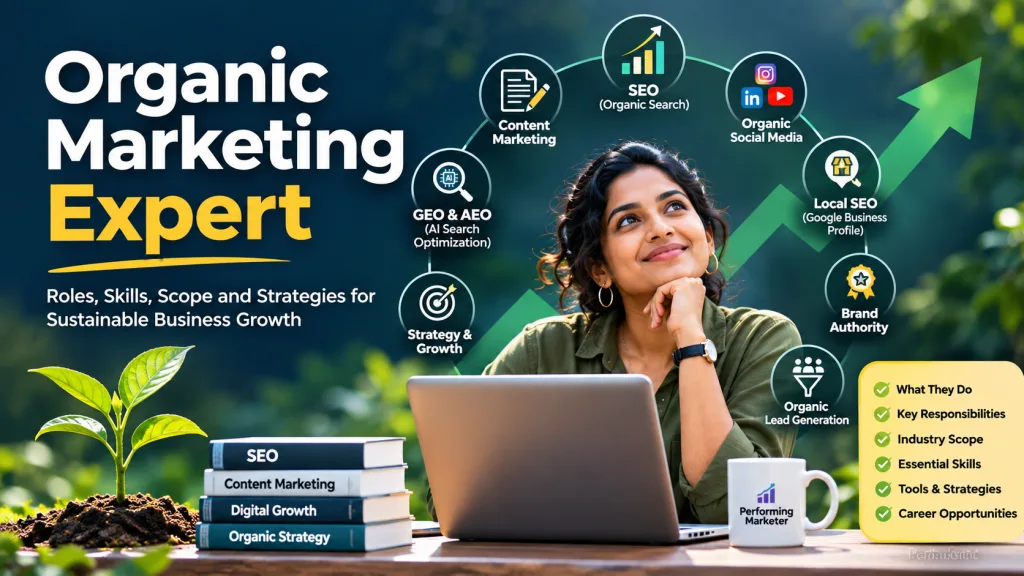
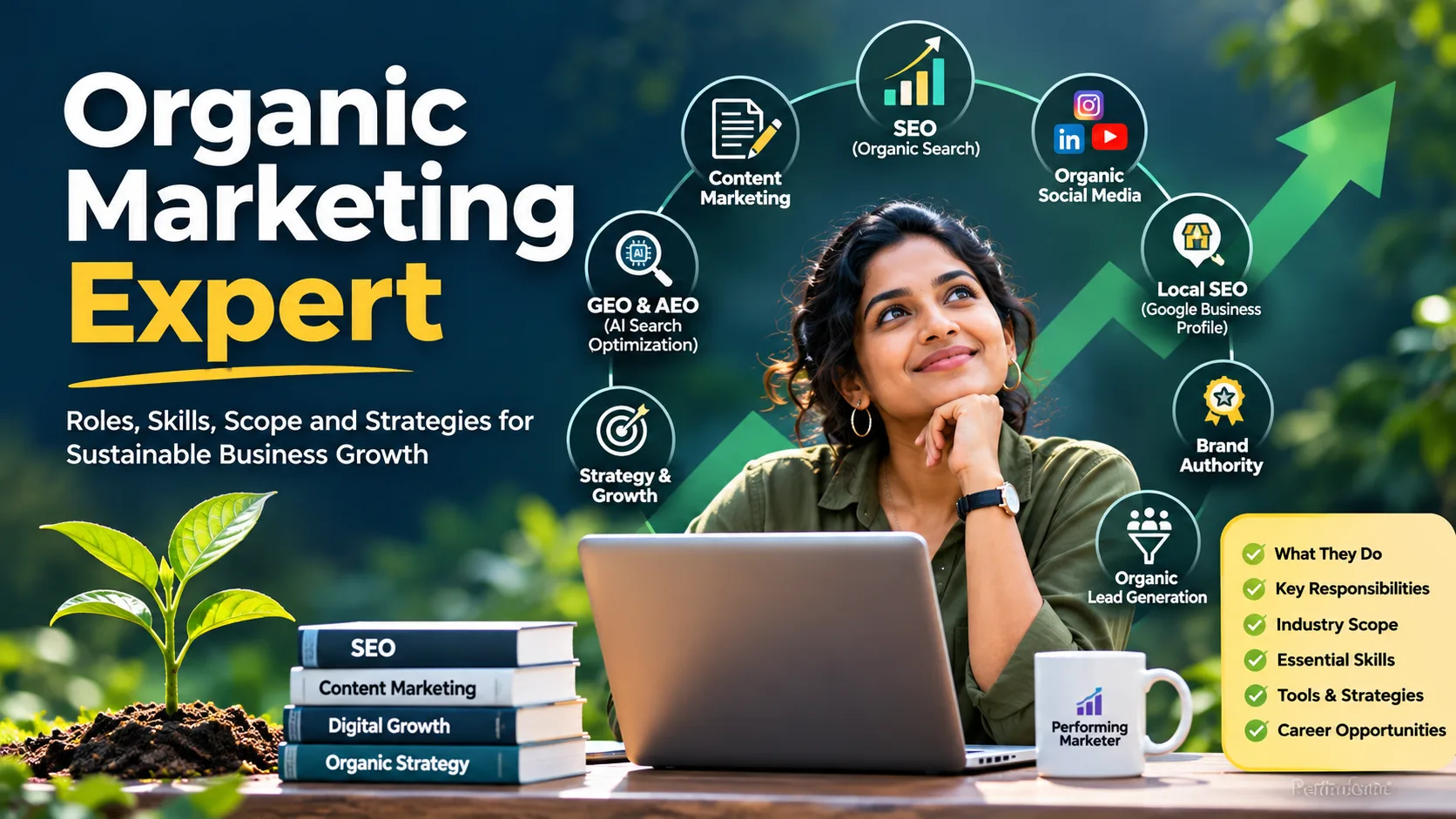
This specialist helps businesses build sustainable online visibility, attract relevant audiences, establish brand credibility and generate potential customers through non-paid digital marketing channels. Instead of depending entirely on advertising budgets, the specialist develops an integrated strategy that combines search engine optimization (SEO), content marketing, organic social media, local search, brand building and audience engagement.
The role is not limited to publishing content or improving Google rankings. It involves understanding business objectives, researching customer behaviour, developing marketing strategies, creating useful content and measuring the impact of organic marketing activities.
In this guide, we will explore how this role supports businesses, its responsibilities, essential skills, professional scope, business applications and the growing importance of SEO, Generative Engine Optimization (GEO) and Answer Engine Optimization (AEO).
1. What Is an Organic Marketing Strategist?
An Organic Marketing Strategist is a digital marketing professional who helps businesses attract, engage and convert audiences through non-paid marketing activities.
These activities include organic search visibility, educational content, social media engagement, local SEO, website optimization, email marketing, online reputation management and brand authority development.
The main objective is to create a sustainable system that helps potential customers discover a business, understand its expertise, develop trust and take meaningful action.
For example, consider a small business in Thrissur that provides interior design services.
Instead of depending only on paid advertisements, a specialist might:
- Optimize the business website for relevant interior design searches.
- Publish helpful articles about home interior planning and budgeting.
- Improve its Google Business Profile.
- Create educational videos showcasing design ideas.
- Develop an organic social media content strategy.
- Build relevant local visibility and brand credibility.
- Improve website enquiry forms and contact pathways.
- Measure organic traffic, qualified enquiries and conversions.
Each activity supports a broader business objective.
Organic Marketing Is More Than Posting Content
One common misunderstanding is that organic marketing simply means posting regularly on Instagram, Facebook or LinkedIn without boosting posts.
Publishing content is only one part of the process.
Effective organic marketing requires research, planning, optimization, distribution, engagement and measurement. A business needs to understand what its customers are searching for, what questions they have, which platforms they use and what information helps them make purchasing decisions.
A skilled practitioner connects these activities into a coordinated strategy.
How Organic Strategies Create Business Value
The professional helps a business move through four important stages:
- Visibility: Helping potential customers discover the business.
- Credibility: Demonstrating expertise through useful and trustworthy information.
- Engagement: Building meaningful relationships with relevant audiences.
- Conversion: Encouraging interested visitors to enquire, contact the business or become customers.
Organic marketing does not mean that a business will never need paid advertising. It means building marketing assets and audience relationships that do not depend entirely on continuous advertising expenditure.
2. Core Responsibilities Across Organic Channels
This professional works across multiple digital marketing channels. The exact responsibilities depend on the business model, industry, target audience and marketing objectives.
2.1 Organic Search and SEO Management
Search engine optimization is one of the most important areas of organic marketing.
The specialist improves a website’s ability to appear in relevant search results and attract visitors who are actively looking for information, products or services.
Typical responsibilities include:
- Keyword research and search intent analysis.
- Technical SEO audits.
- On-page SEO optimization.
- Website structure and internal linking.
- Content optimization.
- Search performance analysis.
- Local SEO implementation.
- Website usability and conversion improvements.
For example, a digital marketing training institute in Kerala may want to attract students searching for a practical digital marketing course in Thrissur.
The specialist can develop relevant course pages, useful educational articles, local search content and a clear website structure that helps prospective students understand the available training options.
The objective is not simply to increase website traffic. It is to attract the right audience.
2.2 Content Marketing and Distribution
Content marketing helps businesses demonstrate expertise and answer customer questions.
The content lead develops content strategies based on audience needs, business expertise and search behaviour.
Content formats may include:
- Educational blog articles.
- How-to guides and tutorials.
- Short-form videos.
- Long-form educational videos.
- Infographics.
- Case studies.
- Frequently asked questions.
- Industry insights.
- Downloadable resources.
A useful content strategy should address different stages of the customer journey.
For example, a person considering a website may initially search for information about website costs. Later, they may compare WordPress developers and agencies. Finally, they may look for a service provider.
A well-planned content strategy can support each stage with relevant information.
Content should be genuinely useful, accurate, original where possible and aligned with the audience’s needs. Publishing large quantities of repetitive or generic material does not automatically create authority.
For a practical overview of the wider discipline, read our complete guide to organic digital marketing strategies.
2.3 Organic Social Media Growth
Social media is another important component of organic marketing.
Businesses can use social platforms to build awareness, communicate expertise, engage with customers and strengthen their online identity.
Responsibilities may include:
- Platform selection.
- Social media content planning.
- Content calendars.
- Educational and promotional content development.
- Community engagement.
- Social profile optimization.
- Video content strategy.
- Performance analysis.
For example, a local bakery in Kerala could publish videos about its baking process, product preparation, customer experiences and seasonal offerings.
These activities give potential customers a better understanding of the business and create opportunities for meaningful engagement.
However, organic reach is not guaranteed. Social platforms control content distribution through their own algorithms, and results can vary over time.
Businesses looking for a more focused approach can explore our guide to organic social media strategy for small businesses.
2.4 Local SEO and Google Business Profile
Local SEO is particularly important for businesses that serve customers in specific geographic areas.
Restaurants, clinics, educational institutions, consultants, home service providers and retail businesses often depend on local discovery.
Typical local search activities include:
- Google Business Profile optimization.
- Accurate business information.
- Relevant local website content.
- Local keyword research.
- Customer review management.
- Location-specific service pages.
- Local business information consistency.
- Local search performance monitoring.
For example, a service provider in Irinjalakuda may want to become more visible to customers searching for relevant services in Irinjalakuda and nearby parts of Thrissur.
The strategy should reflect the business’s actual service areas, customer needs and capabilities. Creating misleading location pages or using fake business information can damage trust.
2.5 Brand Authority and Personal Branding
Customers often research a business before making a decision.
They may visit its website, read articles, watch videos, check customer reviews and look for evidence of professional expertise.
A consistent organic strategy helps build a consistent brand presence across these touchpoints.
Activities may include:
- Developing brand messaging.
- Publishing practitioner-led content.
- Building a professional online profile.
- Creating educational resources.
- Showcasing genuine testimonials.
- Presenting relevant case studies.
- Strengthening the founder’s personal brand.
- Maintaining consistent brand information.
For consultants, coaches, educators and professional service providers, personal branding can be especially valuable.
A professional who regularly shares practical knowledge and demonstrates real experience can give potential customers stronger reasons to consider their services.
2.6 Organic Lead Generation and Conversion Optimization
Generating visitors is not the final objective of organic marketing.
A business also needs a clear process for converting relevant visitors into enquiries and customers.
A specialist may improve:
- Website landing pages.
- Service descriptions.
- Contact forms.
- WhatsApp contact pathways.
- Lead magnets.
- Email newsletters.
- Educational email sequences.
- Calls to action.
- Website navigation.
- Conversion tracking.
For example, someone reading an article about local SEO may be interested in professional assistance.
A relevant consultation link or service page can help that visitor take the next step.
The conversion process should be useful rather than aggressive. Visitors need clear information about the service, its suitability and how to make an enquiry.
3. Key Roles and Responsibilities
The responsibilities of this professional extend beyond individual marketing tasks. The professional must understand how different channels support the overall business strategy.
3.1 Research and Marketing Audits
The first responsibility is understanding the business.
This involves researching:
- Business objectives.
- Target customers.
- Products and services.
- Competitors.
- Customer questions.
- Existing online visibility.
- Website performance.
- Content quality.
- Social media presence.
- Current lead generation methods.
An audit helps identify opportunities and weaknesses before implementing a strategy.
3.2 Organic Marketing Strategy Development
After the research stage, the specialist develops a practical marketing plan.
This may include:
- Defining the target audience.
- Identifying priority search topics.
- Selecting suitable marketing channels.
- Developing content clusters.
- Setting publishing priorities.
- Planning local SEO activities.
- Improving website conversion pathways.
- Defining measurement methods.
The strategy should reflect the available resources and business priorities.
A small business may need a focused plan with a few high-value activities rather than an unnecessarily complicated multi-platform campaign.
3.3 Content Planning and Execution
The marketing lead coordinates content creation and distribution.
This may involve working with writers, designers, video editors, developers and business owners.
The specialist ensures that content supports the overall strategy and maintains consistency in messaging, accuracy and quality.
3.4 Performance Measurement and Reporting
Marketing activities need measurable objectives.
A practitioner may monitor:
- Organic search impressions.
- Search clicks.
- Relevant keyword visibility.
- Organic website traffic.
- Engaged sessions.
- Content engagement.
- Website enquiries.
- Qualified leads.
- Conversion rates.
- Local search interactions.
Useful tools include Google Search Console and Google Analytics 4.
Reporting should explain what the data means for the business. A rise in traffic is not necessarily a success if the visitors are irrelevant or do not contribute to business objectives.
4. What Is the Scope of Organic Marketing?
Organic marketing has applications across different industries and business models.
Its scope continues to evolve as customers discover information through search engines, social platforms, online communities and AI-powered search experiences.
4.1 Small and Medium Businesses
Small businesses can use organic marketing to establish a digital presence, communicate their expertise and attract relevant customers.
Examples include:
- Restaurants publishing menus and useful local content.
- Clinics providing educational information.
- Consultants publishing professional insights.
- Retail businesses creating product guides.
- Home service providers improving local search visibility.
Organic marketing can be especially useful for businesses that need to develop long-term visibility while managing advertising expenditure carefully.
4.2 Startups and Entrepreneurs
Startups often need to build awareness and credibility before they have large marketing budgets.
Organic marketing can help them:
- Explain their products.
- Educate potential customers.
- Develop a brand identity.
- Build an early audience.
- Collect customer feedback.
- Create useful content around their solutions.
A startup should not expect organic marketing to replace every other growth activity. It should use organic channels as part of a balanced business strategy.
4.3 Educational Institutions and Course Creators
Educational businesses can benefit from educational content, search visibility and practitioner-led communication.
For example, a digital marketing training provider may publish:
- Course syllabus information.
- Practical tutorials.
- Career guidance.
- Industry updates.
- Student project examples.
- Frequently asked questions.
- Information about training methods.
This content helps prospective students understand the value of a programme before enquiring.
Course creators can also explore organic marketing strategies for course creators.
4.4 E-commerce Businesses
E-commerce businesses can use organic marketing through product-focused SEO, category content, buying guides, educational videos and customer-generated content.
The strategy should help customers discover relevant products and make informed purchasing decisions.
Product information should be accurate, useful and consistent with the actual items being sold.
4.5 Consultants and Personal Brands
Consultants and independent professionals often sell expertise rather than physical products.
For these businesses, trust and credibility are essential.
Publishing original insights, professional articles, videos, case studies and practical guides can help communicate their knowledge and attract relevant enquiries.
5. Essential Skills for Organic Growth
An effective organic marketing professional needs a combination of technical, creative, analytical and strategic skills.
5.1 Technical and Analytical Skills
Important technical capabilities include:
- SEO fundamentals.
- Keyword research.
- Technical website optimization.
- WordPress website management.
- Google Search Console.
- Google Analytics 4.
- Google Business Profile.
- Website performance analysis.
- Structured data fundamentals.
- Conversion measurement.
The specialist does not necessarily need to perform every technical task personally. However, they should understand how these activities affect organic visibility and business outcomes.
5.2 Content and Creative Skills
Content is central to organic marketing.
A practitioner should understand:
- Audience research.
- Content strategy.
- Copywriting.
- Storytelling.
- Editorial planning.
- Video content development.
- Social media communication.
- Content repurposing.
- Brand voice.
- Content quality evaluation.
The ability to explain complicated subjects in simple language is particularly valuable.
5.3 Strategic and Communication Skills
A marketing professional must understand business objectives and communicate with different stakeholders.
Essential strategic skills include:
- Competitor analysis.
- Customer journey mapping.
- Marketing planning.
- Channel selection.
- Project management.
- Budget prioritization.
- Performance reporting.
- Problem-solving.
- Client communication.
The professional should be able to explain why a particular activity is recommended, what outcome it is intended to support and how its effectiveness will be evaluated.
5.4 AI and Emerging Search Skills
AI tools can support research, content planning, analysis and productivity.
An Organic Marketing Strategist should understand how to use AI responsibly for:
- Research assistance.
- Topic ideation.
- Content outlining.
- Content editing.
- Data interpretation.
- Workflow automation.
- Content repurposing.
- Search intent analysis.
However, AI-generated content should be reviewed for accuracy, originality, relevance and usefulness.
Using AI does not remove the responsibility to provide trustworthy information and demonstrate genuine expertise.
6. Organic Marketing Strategist vs SEO Specialist vs Digital Marketer
These professional roles overlap, but their primary areas of responsibility are different.
| Professional role | Main focus |
|---|---|
| SEO Specialist | Search engine visibility and website optimization |
| Content Marketing Specialist | Content strategy, creation and distribution |
| Social Media Manager | Social platform content and engagement |
| Digital Marketing Manager | Coordination of multiple digital marketing channels |
| Organic Marketing Strategist | Integrated non-paid audience growth, authority and conversion strategy |
How Does This Role Differ from an SEO Specialist?
No.
SEO is an important part of organic marketing, but organic marketing includes several additional channels.
An SEO Specialist may primarily focus on website visibility in search engines.
A broader organic growth strategy considers how SEO, content, social media, local search, reputation and brand communication work together.
For example, a business may rank well for a particular keyword but still struggle to generate enquiries.
An integrated organic marketing strategy would examine not only search visibility but also the quality of the landing page, brand credibility, customer journey and conversion process.
When Does a Business Need Each Professional?
A business that has technical website issues may need an SEO specialist.
A business that needs consistent social media publishing may need a social media manager.
A business that needs an integrated approach to search visibility, content, brand authority and organic lead generation may benefit from an Organic Marketing Strategist.
The right choice depends on the business’s actual challenges.
7. How Organic Marketing Supports Business Growth
A professional organic marketing process should be structured and measurable.
Here is a practical workflow.
Step 1: Understand the Business and Audience
The specialist studies the business model, services, customers, competitors and growth objectives.
Important questions include:
- Who are the ideal customers?
- What problems are they trying to solve?
- What questions do they ask before purchasing?
- Which channels do they use?
- What makes this business different?
Step 2: Conduct an Organic Marketing Audit
The specialist evaluates the current online presence.
This includes reviewing the website, SEO, existing content, social media profiles, local search visibility, online reputation and conversion pathways.
The audit identifies opportunities that can be prioritized.
Step 3: Develop a Strategy
Based on the findings, the specialist creates an organic marketing strategy.
This includes selecting relevant topics, defining content priorities, planning internal links, identifying suitable channels and setting realistic performance objectives.
Step 4: Create and Optimize Useful Content
Content is developed to address genuine audience needs.
A business may publish educational articles, service pages, videos, case studies and answers to frequently asked questions.
The content should demonstrate subject knowledge and provide meaningful value.
Step 5: Distribute and Engage
Publishing content is not enough.
The business should distribute relevant content through suitable channels, participate in relevant communities and respond to customer questions.
Email newsletters and other permission-based communication methods can also help maintain relationships with interested audiences.
Step 6: Measure and Improve
The specialist reviews performance data and identifies what is working.
Activities may be refined based on search performance, content engagement, lead quality and business conversions.
Organic marketing is an ongoing process of learning and improvement rather than a one-time campaign.
8. Organic Marketing for Small Businesses: Practical Examples from Kerala
Small businesses in Kerala operate in different markets, languages and competitive environments.
A local business may serve customers within a few kilometres, while another may provide services across India or internationally.
Organic marketing strategies should reflect these differences.
Example 1: A Local Restaurant in Thrissur
A restaurant could develop its organic presence through:
- Accurate business information on Google Business Profile.
- Useful website information about its menu and services.
- Genuine customer feedback.
- Original food photographs and videos.
- Helpful information about location and accessibility.
- Consistent communication on relevant social platforms.
The objective is to help potential customers discover the restaurant and make an informed decision.
Example 2: A Digital Marketing Consultant in Kerala
A consultant could build authority by publishing:
- Practical SEO guides.
- Google Ads educational content.
- Local SEO tutorials.
- Digital marketing case studies.
- Business growth insights.
- Videos answering common client questions.
A well-structured website can connect these resources with relevant consulting service pages.
For businesses seeking professional local search assistance, see SEO services in Thrissur.
Example 3: A Small Educational Institute
An educational institute could publish detailed course information, learning outcomes, instructor profiles, practical project examples and career guidance.
This helps prospective students understand the programme before contacting the institute.
These are illustrative examples, not guaranteed growth outcomes. Actual results depend on competition, execution, service quality, resources and customer demand.
9. The Role of GEO, AEO and AI in Organic Marketing
The way people discover information online is changing.
Traditional search engines remain important, but people increasingly interact with conversational interfaces and AI-powered search experiences.
Professionals should understand these developments and prepare useful, clearly structured content.
9.1 What Is Generative Engine Optimization (GEO)?
Generative Engine Optimization, commonly called GEO, refers to efforts to improve the likelihood that useful and trustworthy content can be discovered, understood and potentially referenced in generative AI search experiences.
GEO-related content practices include:
- Publishing clear and factual information.
- Demonstrating relevant subject expertise.
- Using descriptive headings.
- Explaining important concepts directly.
- Providing original insights.
- Maintaining accurate business information.
- Supporting claims with reliable evidence.
- Building a clear website structure.
There is no guaranteed GEO ranking formula. Different AI systems use different sources, retrieval processes and selection methods.
The most sustainable approach is to create useful content that genuinely serves people.
9.2 What Is Answer Engine Optimization (AEO)?
Answer Engine Optimization focuses on making information clear and useful for systems that provide direct answers to user questions.
For example, a person may ask:
“What does this professional do?”
A useful article should answer the question directly before providing detailed explanations.
AEO-friendly content practices include:
- Clear definitions.
- Question-based headings.
- Concise explanations.
- Useful comparison tables.
- Well-organized FAQs.
- Accurate terminology.
- Supporting examples.
These practices improve readability and make important information easier to interpret.
9.3 How AI Changes Content Discovery
AI-powered tools can help users summarize information, compare options and explore complex topics.
This creates new opportunities for businesses to communicate their expertise through high-quality digital content.
However, appearing in an AI-generated answer is not guaranteed.
A specialist should focus on building a credible digital presence rather than relying on shortcuts or claims of guaranteed AI visibility.
9.4 Why Experience and Trust Still Matter
AI tools can generate content quickly, but speed alone does not establish credibility.
Businesses should publish information that reflects genuine experience, professional knowledge and accurate evidence.
Original examples, transparent authorship, useful explanations and verifiable claims help demonstrate content quality.
This is closely related to Google’s E-E-A-T framework:
- Experience: First-hand knowledge or practical experience.
- Expertise: Demonstrated subject knowledge.
- Authoritativeness: Recognition and credibility within a relevant subject area.
- Trustworthiness: Accuracy, transparency and reliability.
E-E-A-T is a quality evaluation framework, not a single technical ranking factor or a guaranteed ranking formula.
10. Career Opportunities and Professional Scope
Organic marketing offers several professional pathways for people interested in digital marketing, content, SEO and business growth.
Possible career roles include:
Organic Marketing Specialist
Focuses on implementing organic marketing activities across selected channels.
Organic Growth Strategist
Develops integrated strategies to improve audience acquisition, visibility and conversions through organic channels.
Organic Marketing Consultant
Works with businesses to audit their digital presence, develop strategies and guide implementation.
SEO and Content Strategist
Combines search optimization with content planning and topical authority development.
Local SEO Consultant
Helps location-based businesses improve their presence in local search results.
GEO and AEO Content Strategist
Focuses on making useful information clear, structured and accessible across evolving search and answer experiences.
Freelance Consultant or Agency Founder
Experienced professionals may offer organic marketing services independently or develop specialist agencies.
The opportunities available to an individual depend on their knowledge, experience, communication skills, portfolio and ability to deliver business value.
11. How to Choose the Right Specialist
Choosing the right specialist is an important decision for a business.
The right professional should understand both digital marketing and the business objectives behind it.
Before hiring, consider the following points.
11.1 Check Experience and Portfolio
Review relevant projects, published work, case studies and professional experience.
Ask the specialist to explain their contribution to previous projects.
Do not rely only on impressive screenshots or unsupported performance claims.
11.2 Understand Their Strategy
A good practitioner should explain:
- How they will understand your business.
- Which channels they recommend.
- Why those channels are suitable.
- What activities they plan to prioritize.
- How performance will be measured.
A strategy should be customized rather than copied from another business.
11.3 Evaluate Reporting and Communication
The professional should provide understandable reports that connect marketing activities with meaningful outcomes.
Ask whether they monitor organic traffic, search visibility, enquiries, lead quality and conversions.
11.4 Questions to Ask Before Hiring
- What experience do you have in my industry?
- How will you evaluate my existing online presence?
- Which organic marketing channels do you recommend?
- How will you measure business outcomes?
- What is included in your service?
- How often will you provide reports?
- What challenges should I expect?
- How will you adapt the strategy when results change?
11.5 Red Flags to Avoid
Be cautious of professionals who:
- Guarantee specific Google rankings.
- Promise instant organic growth.
- Use misleading traffic statistics.
- Recommend publishing large volumes of low-quality content.
- Avoid explaining their strategy.
- Cannot connect marketing activities with business objectives.
- Claim guaranteed placement in AI-generated answers.
A trustworthy consultant should communicate realistic expectations and explain the limitations of organic marketing.
12. Tools for Research, Execution and Measurement
Tools help professionals research, implement and measure organic marketing activities.
The right tools depend on the business and the scope of work.
| Tool | Common application |
|---|---|
| Google Search Console | Search performance and indexing information |
| Google Analytics 4 | Website traffic and user behaviour analysis |
| Google Keyword Planner | Keyword research and advertising-related search insights |
| Google Trends | Exploring search interest patterns |
| Google Business Profile | Managing local business presence |
| Semrush | SEO research and competitive analysis |
| WordPress | Website and content management |
| Looker Studio | Marketing dashboards and reporting |
| Canva | Visual content creation |
| ChatGPT | Research assistance, planning, editing and workflow support |
Tools should support professional judgement, not replace it.
A practitioner must know how to interpret information, verify findings and make decisions based on the business context.
13. Common Organic Marketing Mistakes
Businesses often struggle with organic marketing because they focus on individual activities instead of a connected strategy.
Some common mistakes include:
Publishing Without a Strategy
Posting regularly without understanding the audience or business objective can waste resources.
Ignoring Search Intent
A page may contain relevant keywords but fail to answer the actual question behind a search.
Chasing Vanity Metrics
Likes, impressions and follower counts do not always indicate meaningful business growth.
Neglecting Website Conversions
Attracting visitors without providing clear contact options or useful next steps can limit business results.
Depending Entirely on AI-Generated Content
AI-generated material without meaningful review, expertise or original value may be inaccurate or unhelpful.
Ignoring Performance Data
Without measurement, businesses may continue activities that do not support their objectives.
Expecting Immediate Results
Organic marketing generally requires consistency, refinement and time. Results vary by industry, competition, website quality and execution.
14. Frequently Asked Questions
What does this specialist do?
This is a digital marketing professional who helps businesses attract relevant audiences and build sustainable online visibility through SEO, content marketing, organic social media, local search and brand authority development.
Which activities are part of the role?
They research audiences, audit digital presence, develop organic marketing strategies, optimize websites, plan content, improve social media visibility, strengthen local search presence and measure marketing performance.
How does this role differ from an SEO specialist?
No. SEO is one part of organic marketing. The broader role also covers multiple non-paid channels, including SEO, content, social media, local search, reputation and audience engagement.
How long does organic marketing take to show results?
There is no universal timeline. Some activities may generate early engagement, while improvements in search visibility and business conversions may take longer. Results depend on competition, website condition, content quality, consistency and the overall strategy.
Can organic marketing generate leads without paid advertising?
Yes. Organic channels can generate enquiries through search visibility, useful content, local discovery, social media and brand credibility. However, lead generation is not guaranteed, and some businesses may benefit from combining organic and paid marketing.
Which skills are important for this career?
Important skills include SEO, keyword research, content strategy, social media marketing, analytics, website optimization, audience research, communication, conversion optimization and responsible use of AI tools.
How do I hire an Organic Marketing Consultant?
Review the consultant’s experience, portfolio, strategy, communication and reporting methods. Ask how they will understand your business and measure meaningful outcomes. Avoid professionals who promise guaranteed rankings or instant results.
What is the future scope of organic marketing?
Organic marketing is likely to continue evolving as search engines, social platforms and AI-powered discovery systems change. Professionals who combine technical knowledge, original content, customer understanding and measurable business strategy can adapt to these developments.
What is the difference between organic marketing and paid marketing?
Organic marketing focuses on attracting audiences through non-paid channels such as SEO, useful content and organic social media. Paid marketing uses advertising expenditure to reach selected audiences. Both approaches can support business growth, depending on the objectives and resources.
15. Conclusion: Building Sustainable Organic Growth
A well-planned organic strategy helps businesses move beyond isolated digital marketing activities and build a connected growth strategy.
By combining SEO, content marketing, organic social media, local search, brand authority, audience engagement and emerging AI search practices, the professional helps businesses improve how they are discovered, understood and trusted online.
For small businesses, startups, consultants and established brands, organic marketing can become an important long-term investment in digital visibility and customer relationships.
The most effective strategy is not simply about publishing more content or chasing higher rankings. It is about creating useful information, demonstrating expertise, building trust and turning relevant audience attention into meaningful business opportunities.
Looking to build a stronger organic presence for your business?
Performing Marketer helps businesses understand digital marketing opportunities and develop practical strategies for SEO, organic growth and online visibility.
Explore the available digital marketing services or discuss an organic marketing strategy suited to your business goals.
Build visibility. Establish trust. Create sustainable growth.
If you are evaluating outside support, see our guide to choosing an organic digital marketing agency and understanding the services it should provide.