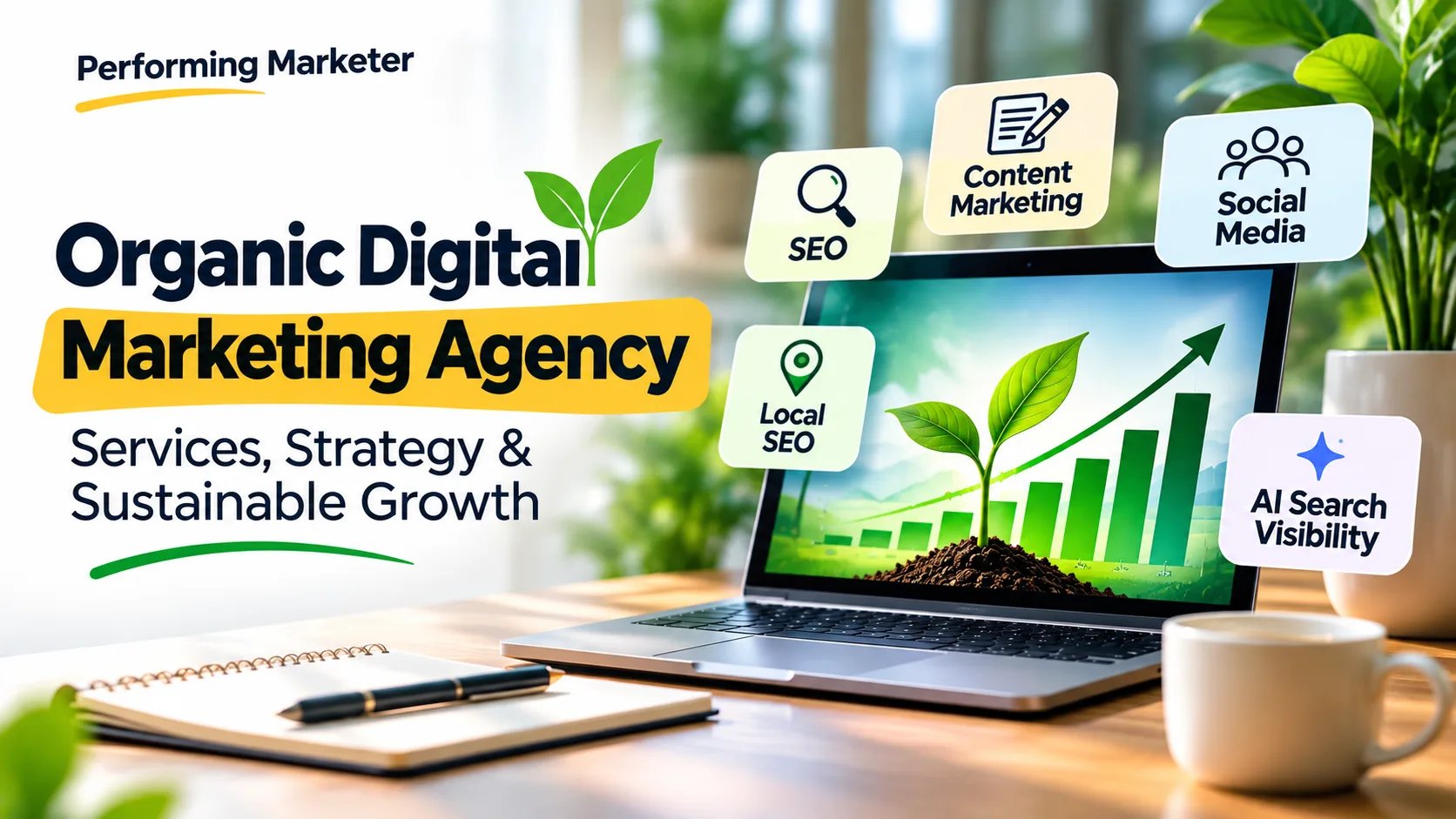
An organic digital marketing agency helps a business attract relevant visitors, enquiries and customers through unpaid digital channels such as search engines, useful content, organic social media and email. Instead of paying for every click, the business invests in assets—pages, videos, reputation and customer relationships—that can continue attracting attention over time.
If advertising costs are rising or enquiries stop whenever campaigns are paused, a well-planned organic growth programme can help build a more durable source of visibility. However, organic marketing takes time, and not every agency offers the same level of expertise or transparency.
This guide explains what an organic digital marketing agency does, which services to expect, how agencies compare with freelancers and in-house teams, and what to check before signing a contract.
What does an organic digital marketing agency do?
An organic digital marketing agency plans and manages marketing activities that improve a brand’s visibility without relying on paid placements for every interaction. It studies the audience, identifies search demand, improves the website, develops useful content and helps distribute that content through relevant channels.
A typical engagement follows four stages:
- Audit and strategy: Review the website, search visibility, competitors, audience needs and existing content. Identify priorities based on business goals.
- Execution: Improve technical and on-page SEO, create helpful pages and resources, and strengthen the website’s information architecture.
- Distribution: Repurpose useful content for social media, email and relevant communities. Build relationships that can earn legitimate mentions and referrals.
- Measurement and improvement: Review organic traffic, qualified enquiries, conversions and revenue contribution. Use the findings to refine the plan.
A good agency should explain why each activity matters and how it contributes to the business—not simply send a monthly list of tasks. For an overview of how Google discovers and presents information, refer to Google Search Central’s explanation of how Search works.
For a broader introduction to the discipline, read our complete guide to organic digital marketing strategies.
Core organic marketing services
The exact service mix depends on the business, its market and its resources. These are the main areas an organic digital marketing agency may cover.
1. Search engine optimisation
SEO helps search engines understand a website and helps people find useful, relevant pages. Work may include technical checks, keyword and intent research, on-page improvements, internal linking, local SEO and content optimisation.
For a local business, this may also include improving its Google Business Profile, service-area information, reviews and location-specific website content. The goal is not to insert a town name everywhere; it is to make the business genuinely useful and discoverable for people in that area.
2. Content marketing
Content marketing turns a business’s knowledge into useful resources such as articles, service pages, case studies, guides, videos and FAQs. A reliable agency should create an editorial plan based on customer questions and business priorities—not just promise a fixed number of blog posts each month.
Content should demonstrate real experience, answer the reader’s question and make the next step clear.
3. Organic social media
Organic social media helps a business build awareness, trust and relationships without paying to boost every post. The work can include content planning, short-form videos, community engagement, customer stories and adapting website content for social platforms.
Read our practical guide to building an organic social media strategy for a small business.
4. Email and customer lifecycle marketing
Email gives a business a direct way to communicate with people who have chosen to hear from it. Agencies may help with newsletter planning, welcome emails, educational sequences, customer retention campaigns and segmentation. Email works best when it provides continuing value rather than sending repeated sales messages.
5. AI-search and answer-engine visibility
People increasingly use AI assistants and answer-focused search experiences to research products, services and questions. Agencies can prepare clear, well-structured content, strengthen entity and brand information, use appropriate structured data and publish trustworthy evidence of expertise.
No agency can guarantee that an AI system will cite a particular website. Ask for a realistic explanation of the work and how visibility will be monitored.
Agency, freelancer or in-house team: which is right?
Choose an agency when you need several complementary skills but do not need—or cannot yet afford—a full internal team. A freelancer may be a better fit for a defined specialist task. An in-house team offers greater day-to-day control and can be appropriate when organic marketing is central to the business and there is enough ongoing work.
| Factor | Agency | Freelancer | In-house |
|---|---|---|---|
| Skills covered | Often several disciplines | Usually one or two specialisms | Depends on the people hired |
| Cost structure | Commonly a monthly retainer or project fee | Hourly or project-based | Salary, benefits and tools |
| Speed to start | Often relatively quick | Often quick | Hiring and onboarding take time |
| Brand knowledge | Builds with collaboration | Depends on the engagement | Can become deep over time |
| Control | Shared through agreed processes | Shared through agreed scope | Direct day-to-day control |
| Best suited to | Businesses needing a coordinated mix | Specific tasks, audits or specialist support | Businesses with sustained workload |
There is no universally best option. Choose based on the work you need, the expertise available and the level of management your business can provide.
How to choose an organic digital marketing agency
The right agency should be able to show relevant experience, explain its process in plain language and connect its work to business outcomes. Use this checklist when comparing providers.
- Relevant case studies: Ask for examples from a similar industry, audience or business model. Look for context and meaningful before-and-after data.
- A transparent process: Understand how the agency audits, prioritises, executes and reports.
- No guaranteed rankings: Search engines control rankings. Be cautious of anyone promising a fixed position or a specific amount of traffic.
- Clear ownership: Confirm that your website, domain, analytics, advertising accounts, content and customer data remain accessible to your business.
- Responsible methods: Ask how the agency earns links and mentions. Avoid manipulative link schemes and mass-produced, low-value content.
- Business-focused reporting: Reports should explain qualified leads, enquiries, conversions and revenue contribution where tracking allows—not only impressions and rankings.
- A named point of contact: Know who is responsible for the account and who actually performs the work.
- Fair contract terms: Check the scope, notice period, deliverables, payment terms and exit arrangements before committing.
Questions to ask during the first meeting
- What would you prioritise in the first 90 days, and why?
- Which metrics will you report, and how do they relate to my business goals?
- Who plans, writes and reviews the content?
- How do you use AI tools, and what human review takes place before publishing?
- What access and ownership will remain with my business if we stop working together?
- What would make you recommend that I do not invest in organic marketing yet?
A trustworthy agency should be comfortable discussing limitations and trade-offs, not just presenting a sales pitch.
What does an organic digital marketing agency cost?
Agencies commonly use one of four pricing models:
| Pricing model | How it works | Often suitable for |
|---|---|---|
| Monthly retainer | A recurring fee for an agreed scope | Ongoing SEO, content and optimisation |
| Project-based | A fixed fee for a defined deliverable | Audits, migrations or a website project |
| Hourly | Payment for time spent | Small tasks or specialist advice |
| Performance-based | Fees linked to agreed outcomes | Situations where attribution and measurement are clearly defined |
The cost depends on the number of channels, the amount and depth of content, the competitiveness of the market, the technical condition of the website and the experience of the team. Prices can vary substantially across locations and providers. Ask for a written scope that lists deliverables, responsibilities, exclusions and reporting.
Do not compare proposals only by the number of articles or keywords included. Compare the quality of the strategy, the work being done and the business problem it is intended to solve.
How long does organic marketing take?
Organic growth is not an instant substitute for paid advertising. The early stage often involves research, technical fixes, content planning and measurement setup. Search visibility and engagement may improve before the business sees a meaningful increase in qualified enquiries.
The timeline varies with the website’s starting point, competition, content quality, authority, resources and consistency. Ask the agency to define leading indicators for the first few months and explain how it will respond if progress is slower than expected. Treat any timeline as an estimate, not a guarantee.
Is an organic agency right for a small business in Kerala?
It can be, provided the plan matches the business’s market, budget and capacity. A local service provider in Thrissur, for example, may need strong service pages, useful local information, a complete Google Business Profile, authentic customer reviews and content that answers common customer questions. A course provider may need educational articles, instructor-led videos, email follow-up and clear course information.
A small business does not necessarily need every channel at once. It may be more effective to build a strong website foundation, focus on the channels customers actually use and expand when the process is working.
Frequently asked questions
What is an organic digital marketing agency?
It is a marketing partner that helps a business attract relevant traffic, enquiries and customers through channels such as SEO, content marketing, organic social media and email rather than paying for every click.
How is organic marketing different from paid marketing?
Paid marketing buys exposure and usually stops delivering paid reach when the budget is paused. Organic marketing builds discoverability and useful content over time. The two approaches can support each other.
Can an agency guarantee first-page rankings?
No credible agency can guarantee a specific search ranking. Search engines determine results. An agency can commit to a clear process, agreed deliverables, responsible methods and transparent reporting.
Should I choose an agency or a freelancer?
Choose an agency if you need coordinated work across several disciplines. Choose a freelancer when you have a specific task or need specialist support. Consider in-house hiring when the workload is steady and organic marketing is a core business function.
Can organic marketing work with a limited budget?
Yes, if priorities are realistic. Start with the website, customer questions and the channels most relevant to your audience. Avoid spreading a small budget across too many activities.
Conclusion: choose a partner, not just a service provider
The right organic digital marketing agency gives your business a clear plan, relevant expertise, transparent reporting and work that can build value over time. Shortlist a few providers, ask the questions above and compare written scopes before making a decision.
If you want to understand where your website’s organic growth opportunities may be, contact Performing Marketer for a discussion. We can help you identify practical priorities for your business.
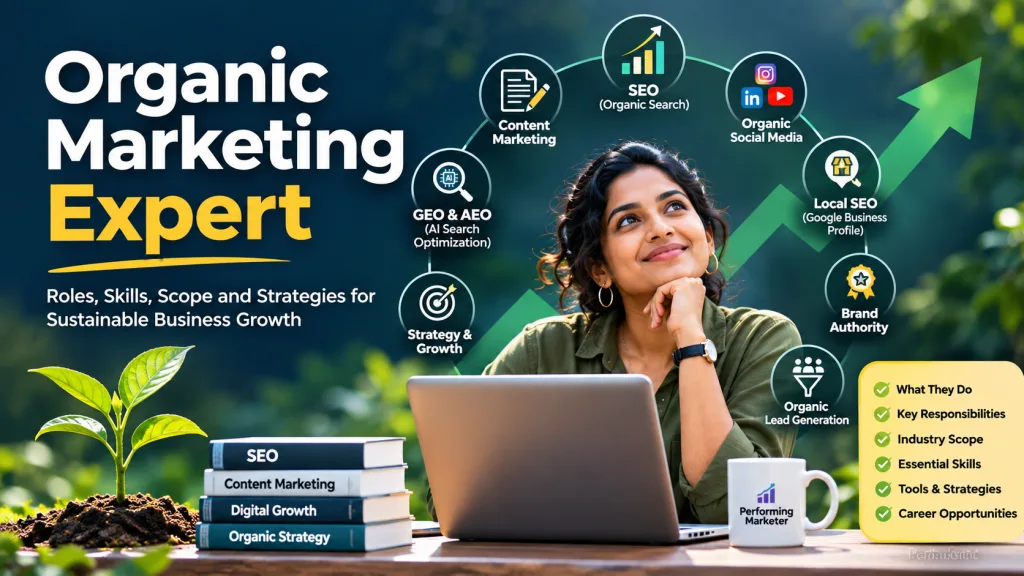
For related perspectives, explore the skills and responsibilities of an Organic Marketing Expert, our guide to organic marketing for course creators and the online marketing challenges faced by many Kerala businesses.