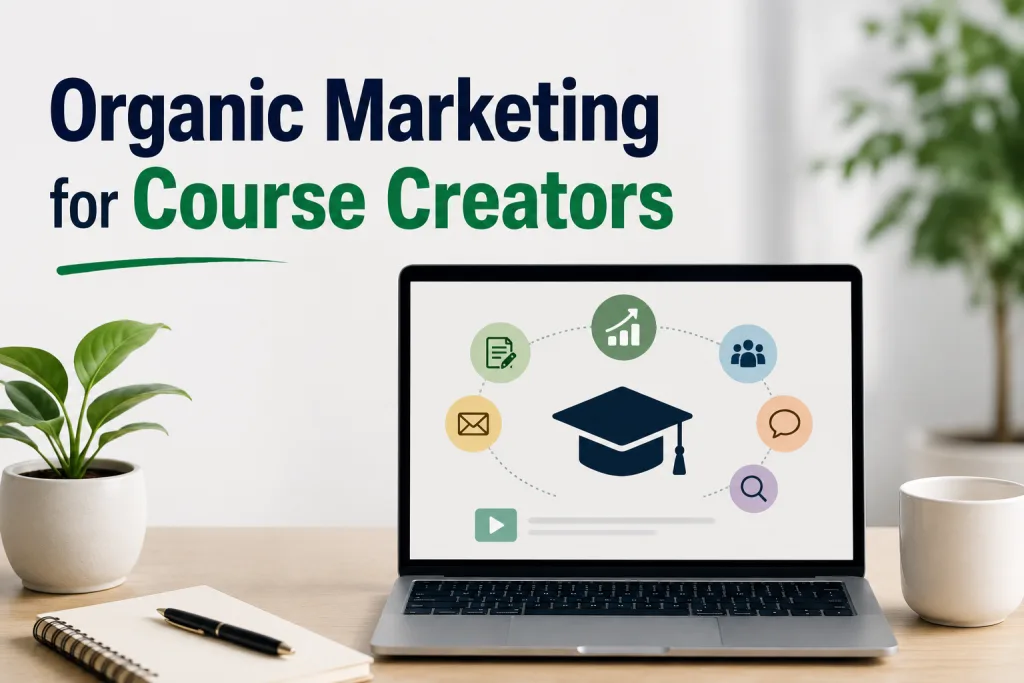
When you’re building an online course, paid advertising might seem like the fastest path to students. But organic marketing offers something more sustainable: genuine authority, loyal students, and predictable revenue that doesn’t depend on ad budgets.
This guide walks you through the proven organic marketing strategies that help course creators attract thousands of students without spending on ads. Whether you’re launching your first course or scaling an existing program, these tactics will help you build a business on your own terms.
Why Organic Marketing Matters for Course Creators
Before diving into tactics, let’s talk about why organic matters.
The paid ad trap: Course creators who rely on ads face rising customer acquisition costs, algorithm changes, and platform dependency. When ads stop working, enrollment stops.
The organic advantage: Students acquired through organic channels—content, SEO, word-of-mouth, email—are typically higher quality, more engaged, and more likely to complete your course and recommend it to others.
The data backs this up. Organic traffic converts better than paid traffic for educational products because students who find you through content have already identified their problem and trust you to solve it.
Key Benefits of Organic Marketing for Courses
- Lower customer acquisition cost: One blog post or video can generate leads for months
- Compounding returns: Your content works 24/7 without ongoing spend
- Positioning: Organic channels build your authority as an instructor, not just a course seller
- Predictability: Once you understand what resonates, you can replicate success
- Better student quality: Organic audiences self-select for genuine interest
1. Content Marketing: Your Foundation
Content marketing is the core of organic course promotion. It serves two purposes: it attracts potential students and demonstrates your expertise.
The Content-to-Course Funnel
Your content strategy should mirror your student’s journey:
- Awareness content (blog posts, videos, podcasts) reaches people searching for solutions to the problems your course solves
- Consideration content (guides, comparisons, case studies) helps prospects understand different approaches and why yours is valuable
- Decision content (testimonials, course previews, FAQs) helps qualified prospects choose to enroll
Content Formats That Drive Enrollment
Blog posts remain the backbone of organic course promotion. Here’s why: they’re discoverable through search, shareable on social, and quotable in emails. Target long-tail keywords related to the problems your course solves.
Example: If you teach email marketing to e-commerce brands, write about “how to build an email list for Shopify stores” or “email sequence templates for Black Friday sales.”
YouTube videos offer huge potential for course creators. YouTube is the second-largest search engine, and video builds stronger parasocial connection than text. Aim for 1-2 videos per week focused on teaching, not selling.
Email newsletters nurture the audience you’ve built. Send weekly insights related to your course topic. Include a soft pitch for your course in your email signature or monthly CTA.
Podcasts and audio capture attention during commutes and workouts. Start a podcast interview show where you discuss course-related topics with experts, or repurpose your best written content as audio.
Lead magnets exchange free value for email addresses. Create a PDF guide, checklist, template, or mini-course related to your full course. This is your fastest path to building an email list.
Content Calendar Best Practices
Consistency beats perfection. Create a realistic content calendar:
- High-volume creators: 2-3 pieces per week (blog, video, email)
- Moderate volume: 1-2 pieces per week
- Starting out: 1 high-quality piece per week
Track what performs. Monitor which topics get shared, which drive course inquiries, which attract your ideal student. Double down on winners.
2. Search Engine Optimization (SEO)
Organic traffic from Google is worth 10x traffic from social media for course promotion. Here’s why: searchers have clear intent, high purchase readiness, and are actively solving a problem.
Keyword Research for Course Creators
Start by identifying the problems your course solves, then find the words people search for when experiencing those problems.
Your course topic → Student’s search query
- Course: “Freelance Writing for Beginners” → Search: “how to start freelance writing” (5,400 monthly searches)
- Course: “Facebook Ads for E-commerce” → Search: “Facebook ads for Shopify” (1,100 monthly searches)
- Course: “Personal Brand Building” → Search: “how to build personal brand on LinkedIn” (2,900 monthly searches)
Use tools like [Ahrefs Keyword Explorer, SEMrush, or Moz Keyword Research] to identify search volume, competition, and related keywords.
On-Page SEO Essentials
When you write content targeting a keyword, optimize these elements:
Title tag (50-60 characters): Include your primary keyword naturally. “Freelance Writing for Beginners: Your 2024 Complete Guide”
Meta description (150-160 characters): Write a compelling summary that includes your keyword and a reason to click. “Learn how to start freelance writing, find your first clients, and set rates. Step-by-step guide for 2024.”
H1 and heading structure: One H1 per page. Use H2s for major sections, H3s for subsections. Include keywords naturally.
Body content: Write for humans first, search engines second. Include your primary keyword 3-5 times naturally. Use secondary keywords 2-3 times.
Internal linking: Link to other relevant content on your site. If you have a post on “finding freelance writing clients,” link to it from your course landing page.
Learn technical SEO best practices
Building Topical Authority
Google rewards sites that go deep on specific topics. Instead of scattered content, create pillar content and cluster content:
- Pillar content: A comprehensive guide on your core topic (5,000+ words)
- Cluster content: Specific posts diving into subtopics, all linking back to the pillar
Example for a “Business Writing” course:
- Pillar: “The Complete Guide to Business Writing” (links to all related posts)
- Clusters: “How to Write Professional Emails,” “Business Writing for Non-Native Speakers,” “Proposal Writing 101,” each linking to the pillar
This structure signals authority to Google and creates multiple entry points for students.
3. Email Marketing: Your Owned Channel
Email is the most direct line to potential and existing students. Unlike social platforms (where algorithms decide who sees your content), email gets delivered to everyone who opts in.
Building Your Email List
Your email list is your most valuable asset. It doesn’t disappear when algorithms change. Start building from day one:
On your website: Offer a lead magnet in exchange for email. Place signup forms in high-traffic locations (sidebar, end of posts, exit-intent popup).
On social media: Direct traffic to your email signup, not just your course page. “Get free email templates” works better than “Enroll now.”
In your content: Include CTAs in videos, podcasts, and guest articles. “Download the full checklist—it’s not in the article” drives signups.
Email Sequences That Sell
Welcome sequence (3-5 emails): Delivered immediately after signup. Introduce yourself, share your story, provide immediate value, soft pitch your course.
Newsletter (weekly): Share insights, teach briefly, tell stories. Include a monthly CTA to your course.
Promotional sequence: When launching or relaunching a course, send 5-7 emails over 2 weeks. Each email takes a different angle: problem statement, social proof, objection handling, FOMO.
Nurture sequence: For visitors who don’t buy immediately, send 10-15 emails over 30 days addressing common objections and sharing testimonials.
The goal isn’t to constantly pitch. The goal is to stay top-of-mind so when your prospect is ready to learn, they think of you.
4. Building Community and Word-of-Mouth
Your students are your best marketers.
Encourage Referrals
Make it easy for happy students to recommend your course:
- Include a referral link in course materials and emails
- Offer incentives (discount on next course, bonus content, cash reward)
- Ask for referrals at the right moment (end of course when satisfaction is highest)
Create Student Communities
Build a private Slack, Discord, or Circle community for your students. This serves multiple purposes:
- Increases engagement and course completion
- Creates accountability and peer learning
- Generates word-of-mouth as members promote the course to bring friends
- Provides feedback for improving your course
Guest Posting and Partnerships
Write for established platforms in your niche:
- Find blogs with active audiences and course learners
- Write one exceptional piece for their audience
- Include a bio with a link to your lead magnet or course
- Build relationships with platform owners for future promotions
Speaking and Authority Building
Appear on:
- Podcasts in your niche
- Webinars hosted by complementary brands
- Conference panels and workshops
- Virtual summits
Each appearance reaches a new audience and positions you as an expert. Include a course offer or lead magnet in your speaker bio.
5. Social Media: Niche Over Reach
Organic social media reach has declined significantly, but strategic social media still drives enrollment when done right.
Platform Strategy
LinkedIn: Best for B2B courses. Share insights, stories, and course-relevant observations. Engage genuinely with others’ content. LinkedIn’s algorithm favors authentic engagement.
YouTube: Invest heavily here. Create valuable content (tutorials, course previews, student success stories) that attracts subscribers who become students.
TikTok/Instagram Reels: Trending for courses targeting younger audiences. Short educational content, course previews, and behind-the-scenes content work well.
Twitter/X: Share insights and join conversations. Build community with other creators and your audience.
Pinterest: Highly underutilized by course creators. Create pin designs that link to your blog content and landing page. Each pin can drive traffic for months.
Social Media Best Practices
- Post consistently: 3-5x per week on your primary platform
- Optimize for platform: TikTok videos ≠ LinkedIn posts. Adapt content to each platform
- Engage authentically: Spend 20% posting, 80% engaging with others’ content
- Use analytics: Track which topics get engagement and which drive traffic and conversions
- Link strategically: Point to content (not just course page). Let content do the convincing
6. Analytics and Optimization
You can’t improve what you don’t measure.
Key Metrics to Track
Content metrics:
- Blog traffic by post
- Average time on page
- Bounce rate
- Share count
Funnel metrics:
- Website visitors
- Lead magnet signups
- Email list growth rate
- Lead-to-student conversion rate
- Cost per acquisition (organic channel cost / enrollments)
Course metrics:
- Enrollment source (organic search, email, referral, social, etc.)
- Revenue by channel
- Customer lifetime value by source
Monthly Optimization Process
- Analyze: Review your top-performing content, top enrollment sources, and top converting funnels
- Identify: Which channels deliver the most engaged students? Which content types resonate most?
- Double down: Create more of what works. Invest time in winning channels
- Improve: Update underperforming content. Test new angles on topics that interest your audience
- Iterate: Repeat monthly
Set aside 10-15% of your time for testing new channels or formats.
7. Course Structure for Organic Success
Your course itself impacts your organic marketing.
Student Success = Word-of-Mouth
Students who complete your course and achieve results tell others. Students who don’t complete or don’t see results tell others too.
Design for completion:
- Reasonable course length (not overwhelming)
- Clear learning outcomes each module
- Practical assignments and immediate application
- Supportive community or feedback mechanism
Pre-Launch: Build Your Audience First
Don’t launch your course into a void. Build your email list and social following first:
- Spend 3-6 months creating free content and building an audience
- Launch your lead magnet and start building your email list
- Create a “coming soon” list for your course
- When you launch, email your list and leverage social following
Courses with audiences launch successfully. Courses without audiences struggle.
Continuous Improvement
Your course is a living product:
- Gather student feedback after each cohort
- Update modules with new examples and data
- Refresh videos and resources annually
- Ask students what they’d recommend to others