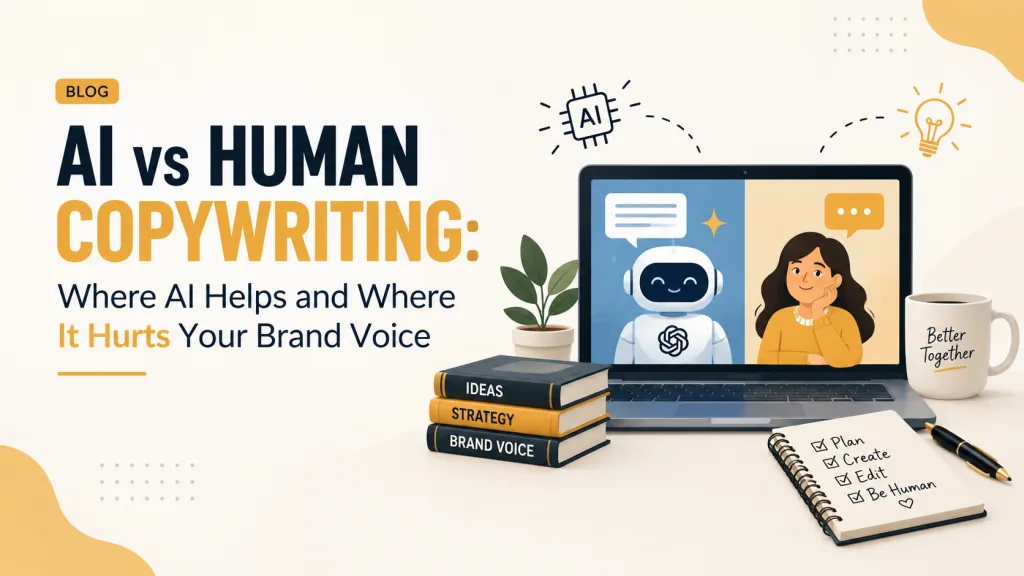
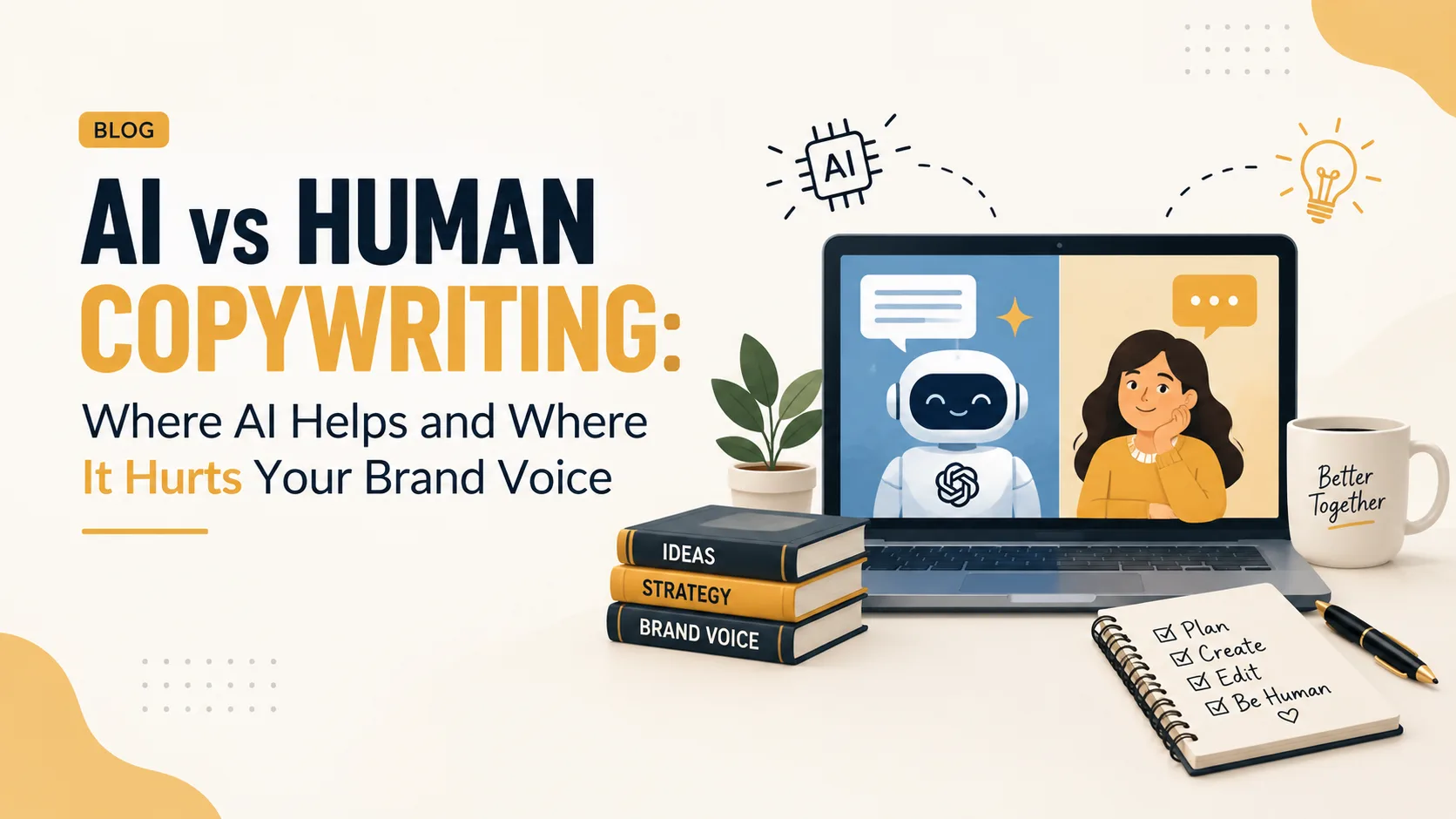
Every marketing team has had the same conversation this year: should we just let AI write this?
The honest answer is “sometimes.” AI copywriting tools have gotten remarkably good at producing clean, grammatically correct, on-brief copy in seconds. But “good copy” and “copy that sounds like your brand” are not the same thing—and the gap between them is where a lot of companies are quietly losing trust with their audience.
Here’s a practical breakdown of where AI genuinely helps your content process, where it hurts your brand voice, and how to combine both without sounding like everyone else’s AI-generated content.
Where AI Copywriting Actually Helps
1. First drafts and volume work
AI is excellent at getting you from a blank page to a working draft. Product descriptions, meta descriptions, social captions, internal documentation, first-pass email subject lines—anywhere you need many pieces of decent copy quickly, AI removes the friction of starting from zero.
2. Structural and SEO scaffolding
AI tools are reliable at generating outlines, headers, and keyword-aware structure. If you’re producing a large volume of SEO content—category pages, FAQ sections, location pages—AI can handle the repetitive structural work while a human focuses on the parts that actually differentiate the page.
3. Editing, tightening, and repurposing
AI is a strong second pair of eyes: cutting filler words, reformatting a blog post into social snippets, and translating a long-form piece into a shorter executive summary. This is arguably where AI adds the most value with the least brand risk, because it’s operating on content a human already wrote.
4. Research synthesis
Summarizing competitor pages, pulling together talking points from multiple sources, or organizing customer feedback themes—AI speeds up the unglamorous research work that used to eat hours before a writer even started drafting.
Where AI Hurts Your Brand Voice
1. It defaults to “safe” and generic.
Left unguided, AI tends toward the statistically average sentence—which is exactly the opposite of a distinctive brand voice. If your brand has a specific point of view, sense of humor, or way of talking to customers, AI will smooth that out unless it’s heavily directed and edited.
2. It can’t hold a genuine point of view.
Good brand copy often takes a stance—on an industry problem, a competitor’s approach, or a customer pain point. AI tools are trained to be balanced and non-committal by default. That’s useful for neutral content, but it flattens the opinionated writing that builds trust and differentiation.
3. It doesn’t know what actually happened
Case studies, founder stories, and “here’s what we learned” content depend on real, specific detail—the kind that only comes from someone who lived it. AI can write around a story convincingly, but it will often fabricate or generalize specifics if not fed the real facts directly, which is a serious risk for credibility and accuracy.
4. Repeated patterns become detectable—and generic.
AI models tend to reuse certain sentence structures, transition phrases, and rhythms. Readers (and increasingly, search engines) are getting better at recognizing this pattern. Over time, brands that publish AI copy without a strong editing layer start to sound like every other AI-assisted brand, not like themselves.
5. Emotional nuance gets lost.
Copy that needs to carry empathy—apology emails, sensitive announcements, community responses—requires judgment about tone that AI simply doesn’t have. Getting this wrong isn’t just a style issue; it can damage customer relationships.
| Task | Best Owner |
|---|---|
| First draft / outline | AI |
| Brand voice, POV, and final tone | Human |
| High-volume, low-risk pages (FAQs, product specs) | AI, lightly edited |
| Hero copy, brand messaging, taglines | Human, AI-assisted at most |
| Case studies, founder stories, testimonials | Human |
| Editing for length/clarity | AI |
| Sensitive or high-stakes communication | Human |
The general rule: the more a piece of content depends on your specific brand identity or a real human experience, the more human involvement it needs. The more a piece of content is structural, repetitive, or low-stakes, the more AI can carry the load.
How to Use AI Without Losing Your Brand Voice
- Build a real voice guide first. Not just adjectives (“friendly,” “bold,” “confident”) but actual example sentences—things your brand would and wouldn’t say. Feed this to whatever AI tool you use.
- Never publish AI copy unedited. Treat AI output as a draft from a junior writer who doesn’t know your brand yet—useful, but it needs a real editorial pass.
- Keep humans on anything customer-facing and high-stakes. Homepage messaging, crisis communication, and anything tied to real customer stories.
- Use AI to edit human writing, not just generate it. Some of the best results come from a human writing the first draft and AI helping tighten and restructure it—reversing the usual workflow.
- Watch for voice drift over time. Periodically compare new content against older, pre-AI content. If the tone has quietly shifted toward generic, that’s a signal to tighten the editorial process.
The Bottom Line
AI copywriting isn’t a replacement for a strong brand voice—it’s a productivity tool that works best inside a system a human still controls. The brands that get the most value from AI aren’t the ones using it the most; they’re the ones who’ve been precise about where to use it and disciplined about keeping a human hand on anything that actually represents the brand.