If you’ve been researching a career or a course, you’ve probably run into these two terms being used almost interchangeably. Job listings ask for “digital marketing skills” one day and “performance marketing experience” the next. Course brochures use both terms on the same page. It’s confusing — and it’s costing people the wrong career decisions.
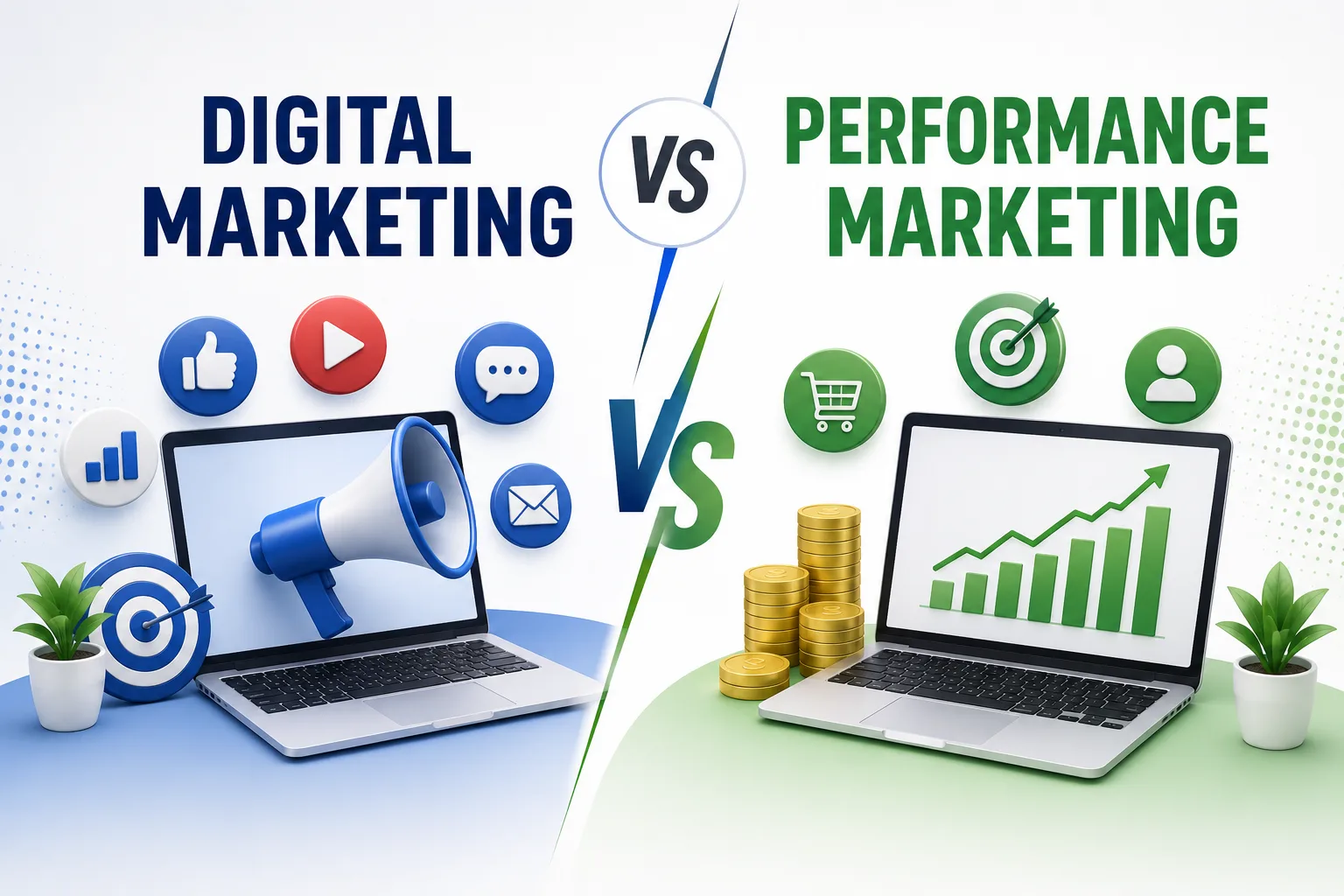
Here’s the short version: performance marketing is a subset of digital marketing. Every performance marketer is a digital marketer, but not every digital marketer is a performance marketer. The real difference isn’t the channels you use — it’s how your work gets measured.
Digital Marketing: The Broad Umbrella
Digital marketing covers every way a business promotes itself online. That includes:
- Search engine optimization (SEO)
- Social media management and content
- Email marketing
- Content marketing and blogging
- Brand building and online reputation
- Paid advertising (this is where performance marketing lives)
A digital marketer’s job is often about building presence over time — growing an audience, improving brand recall, keeping a content calendar running, and slowly compounding organic reach. Success is measured in things like engagement, reach, followers, website traffic, and brand awareness. These matter, but they’re not always tied to a rupee figure you can point to on a spreadsheet.
Performance Marketing: Pay for Results, Not Effort
Performance marketing is the specific discipline of running paid campaigns — Google Ads, Meta Ads, YouTube, programmatic display — where you only pay for measurable outcomes: a click, a lead, an install, a sale. Nothing about performance marketing is vague. Every rupee spent has to justify itself against a number.
A performance marketer lives inside metrics like:
- CTR (click-through rate) — is the ad interesting enough to click?
- CPC (cost per click) — what are you paying per visitor?
- CPL (cost per lead) — what does one enquiry actually cost you?
- ROAS (return on ad spend) — for every rupee spent, how many came back?
There’s no room for “brand awareness” as an excuse if the campaign isn’t converting. That’s the discipline — and it’s also why performance marketing roles tend to pay well early in a career. Businesses can directly see what you’re worth because your work shows up in their revenue numbers, not just their follower count.
Where People Get Confused
The overlap happens because performance marketers still need digital marketing fundamentals — they need to understand the brand, write copy that resonates, and know the customer journey. And digital marketers increasingly run some paid ads to boost a post or promote content. That shared ground is real, but it doesn’t make them the same job.
Think of it this way:
| Digital Marketing | Performance Marketing | |
|---|---|---|
| Scope | Broad — SEO, content, social, email, ads | Narrow — paid ads and conversion tracking |
| Timeline | Long-term brand building | Short feedback loops, often daily |
| Success metric | Reach, engagement, brand recall | CTR, CPL, CPC, ROAS |
| Core skill | Content strategy, consistency | Data analysis, budget optimization, testing |
| Accountability | Harder to tie directly to revenue | Directly tied to spend and return |
Why This Distinction Matters for Your Career
If you’re choosing between a digital marketing course and a performance marketing course, the difference shapes what your day-to-day work will actually look like.
Go broad (digital marketing) if you want variety — planning content, managing social pages, working across SEO and email, and eventually owning a brand’s entire online presence. This path suits people who enjoy creative and strategic work more than staring at dashboards.
Go deep (performance marketing) if you want to work with live ad accounts, real budgets, and numbers that move daily. This path suits people who like problem-solving, testing hypotheses, and seeing an immediate cause-and-effect between a change they make and a result in the data. It’s also the faster route into agency and in-house paid media roles, because businesses can measure your impact from week one.
In practice, most strong marketers eventually pick up both skill sets — but early in your career, specializing in performance marketing gives you a sharper, more hireable skill that’s harder to fake in an interview. You either know how to read a campaign dashboard and explain why CPL went up, or you don’t.
The Practical Takeaway
Don’t pick a course based on which term sounds more impressive. Ask yourself what kind of work you actually want to do:
- Building a brand’s story and presence over months → digital marketing
- Running live ad campaigns and being judged on ROAS every week → performance marketing
If it’s the second one, you’ll want training that puts you inside real ad accounts from day one — not just theory about how Google Ads works, but hands-on time actually running campaigns, tracking conversions, and optimizing budgets under mentorship. That’s the gap between knowing the definitions and being job-ready.
Curious what a hands-on performance marketing program looks like in practice? Explore the Performance Marketing Course to see how live campaign training works.