The way people discover brands online is changing faster than most businesses realize. For years, digital visibility was primarily dependent on traditional SEO strategies focused on keywords, rankings, backlinks, and website traffic. Brands competed to appear on the first page of search engines, hoping users would click through to their websites and convert into customers.
Today, that model is rapidly evolving.
Modern discovery no longer happens only through search engine result pages. People are increasingly finding brands through AI-powered platforms such as ChatGPT, Perplexity, Google AI Overviews, Reddit discussions, YouTube videos, TikTok recommendations, voice assistants, and AI-generated answers. In many cases, users are not even visiting websites anymore. Instead, AI systems summarize information, recommend brands directly, and provide answers within their own interfaces.
This shift is transforming digital marketing entirely.
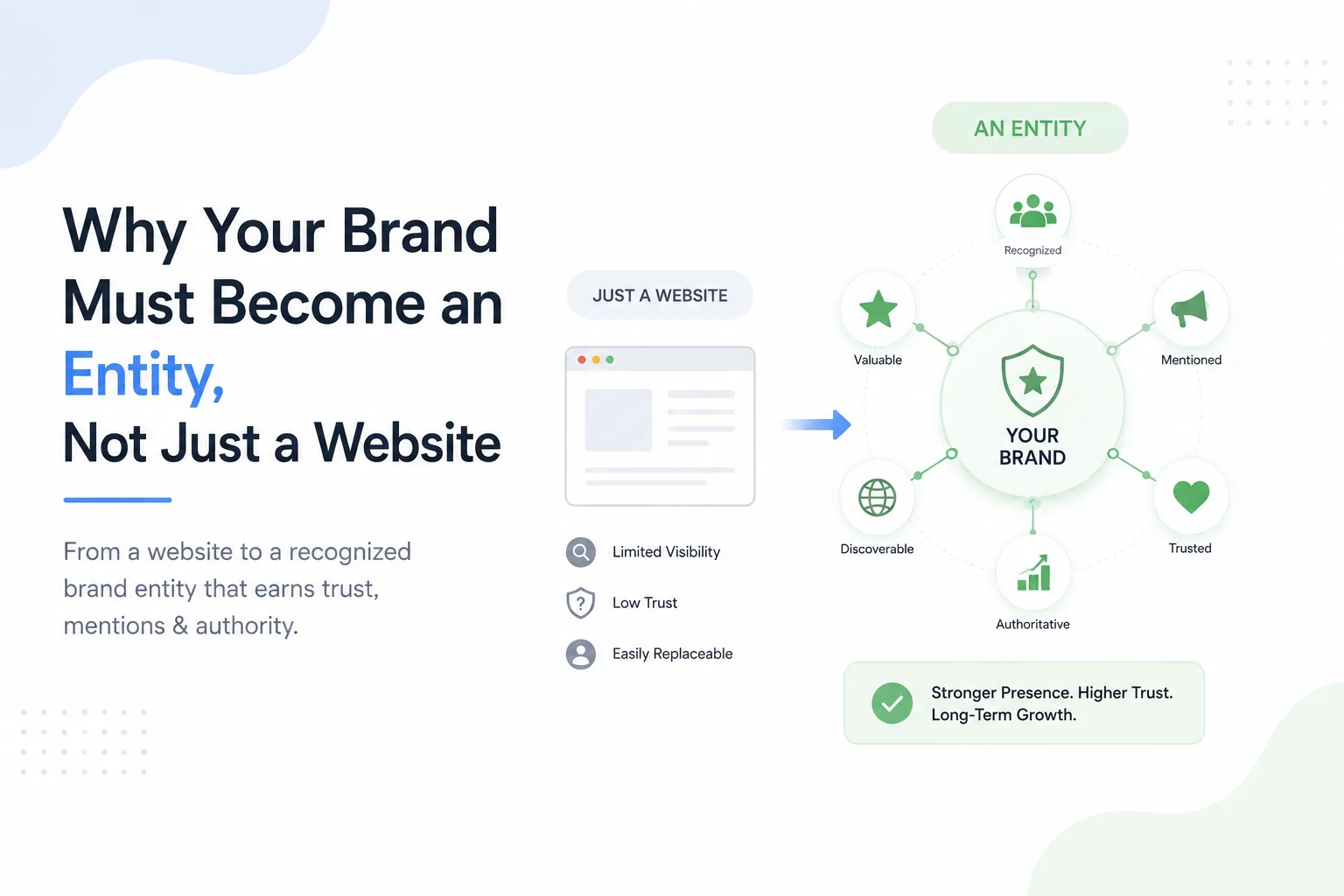
In this new environment, having a website alone is no longer enough. Your brand must evolve into an identifiable digital entity that search engines, AI systems, and knowledge graphs can recognize, trust, and reference across multiple platforms.
Understanding the Shift From Websites to Entities
Traditional SEO treated websites as the central asset of online visibility. The objective was simple: optimize pages around keywords and improve rankings in search results.
However, modern AI-driven search works differently.
AI platforms no longer rely solely on matching keywords to webpages. Instead, they attempt to understand relationships, context, credibility, expertise, and brand identity. Search engines now focus on entities rather than isolated webpages.
An entity is a clearly identifiable person, business, organization, product, or concept that exists independently across the web. Search engines and AI systems use entities to understand who you are, what you do, where you operate, and how authoritative your brand is within a specific industry.
For example, a local digital marketing consultant is no longer evaluated only by website rankings. AI systems analyze whether the brand is consistently mentioned across:
- Business directories
- Social media platforms
- Podcasts
- News websites
- YouTube videos
- Online reviews
- Reddit discussions
- Industry blogs
- Google Business Profile
- Structured data and schema markup
The more consistent and credible your brand signals are, the stronger your entity becomes.
Why AI Search Engines Prefer Entities
AI-driven platforms are designed to provide accurate, trustworthy, and contextually relevant answers. To achieve this, they depend heavily on entity recognition.
When someone asks:
“Who is the best digital marketing mentor in Kerala?”
or
“Which digital marketing consultant specializes in performance marketing?”
AI systems do not simply scan keyword-optimized webpages. Instead, they evaluate entity-level signals such as:
- Brand authority
- Expertise
- Online mentions
- Reviews
- Reputation
- Consistency across platforms
- Topical relevance
- Real-world trust signals
This is why some brands get repeatedly mentioned inside AI-generated answers while others remain invisible despite having well-optimized websites.
The future of visibility belongs to brands that establish strong entity recognition across the digital ecosystem.
Keywords Are Declining, Context Is Rising
Traditional SEO depended heavily on exact-match keywords. Businesses optimized pages around phrases like:
- “Best SEO expert in Kerala”
- “Digital marketing agency in Irinjalakuda”
- “Google Ads consultant”
While keywords still matter, AI search engines now prioritize contextual understanding over exact keyword matching.
For example, if your brand consistently publishes high-quality content about:
- SEO strategies
- Google Ads
- Performance marketing
- Local SEO
- AI search optimization
AI systems begin associating your entity with those topics naturally.
This process is called semantic association.
Instead of asking:
“Does this webpage contain the exact keyword?”
AI systems now ask:
“Is this brand genuinely authoritative in this subject area?”
That is a massive shift in how visibility works online.
Your Brand Exists Beyond Your Website
One of the biggest misconceptions businesses still have is believing that their website alone defines their online presence.
In reality, your digital identity is distributed across the internet.
AI systems gather information from multiple sources simultaneously, including:
- Google Business Profiles
- LinkedIn profiles
- YouTube channels
- Reddit discussions
- Press mentions
- Podcast interviews
- Customer reviews
- Social media engagement
- Citations and references
- Industry directories
Your brand entity is essentially the combined understanding created from all these sources.
This means businesses must move beyond isolated SEO strategies and focus on ecosystem visibility.
The brands winning in 2026 are not simply ranking websites. They are building omnipresent digital authority.
The Rise of Zero-Click Discovery
Another reason entity optimization matters is the growth of zero-click search experiences.
Users increasingly receive answers directly inside:
- AI chat interfaces
- Google AI Overviews
- Featured snippets
- Voice assistants
- Knowledge panels
- Social platform recommendations
This means users often make decisions before ever visiting a website.
For example, someone searching for:
“Best performance marketing consultant in Kerala”
may immediately see:
- AI-generated recommendations
- Review summaries
- YouTube explanations
- Reddit discussions
- Google Business details
The decision-making process now happens within the search ecosystem itself.
If your brand entity is weak, AI systems may never mention you — even if your website ranks reasonably well.
Structured Data and Entity SEO
Technical SEO still plays an important role in entity building.
Structured data, also known as schema markup, helps search engines understand your business more clearly. It provides machine-readable context about:
- Business name
- Founder
- Services
- Location
- Expertise
- Social profiles
- Reviews
- FAQs
- Organization details
When properly implemented, schema markup strengthens your entity relationships within search engine knowledge graphs.
This improves your chances of appearing in:
- AI-generated answers
- Rich snippets
- Knowledge panels
- Voice search results
- Google AI Overviews
Technical SEO is no longer just about crawling and indexing. It is now about helping AI systems understand your identity.
Authority Is the New Ranking Factor
The modern web rewards authority more than isolated optimization.
Authority today is built through:
- Consistent publishing
- Expert-driven content
- Brand mentions
- Digital PR
- Community participation
- Video content
- User engagement
- Trustworthy reviews
- Multi-platform presence
This is why personal branding is becoming increasingly important for consultants, coaches, trainers, and service businesses.
People trust recognizable entities more than anonymous websites.
AI systems are designed similarly. They prioritize trusted brands with established expertise and strong digital footprints.
What Businesses Must Do Next
To remain visible in the AI-driven future of search, businesses must rethink their digital strategy entirely.
The focus should now include:
- Building a recognizable brand identity
- Publishing authoritative topical content
- Creating platform-wide consistency
- Strengthening Google Business Profile signals
- Investing in digital PR and mentions
- Optimizing structured data
- Expanding visibility across YouTube, Reddit, LinkedIn, and social platforms
- Encouraging authentic reviews and discussions
- Establishing subject-matter expertise
SEO is no longer disappearing. It is evolving into a broader visibility strategy centered around entities, trust, and influence.
Conclusion
The future of digital discovery is no longer limited to websites and keyword rankings. AI systems are reshaping how people find, evaluate, and trust brands online.
Businesses that continue focusing only on traditional SEO may gradually lose visibility as AI-powered discovery platforms become dominant.
The brands that will succeed in the coming years are those that become recognized digital entities — trusted, referenced, discussed, and understood across the web.
Your website is no longer the destination.
Your brand itself is the signal.